
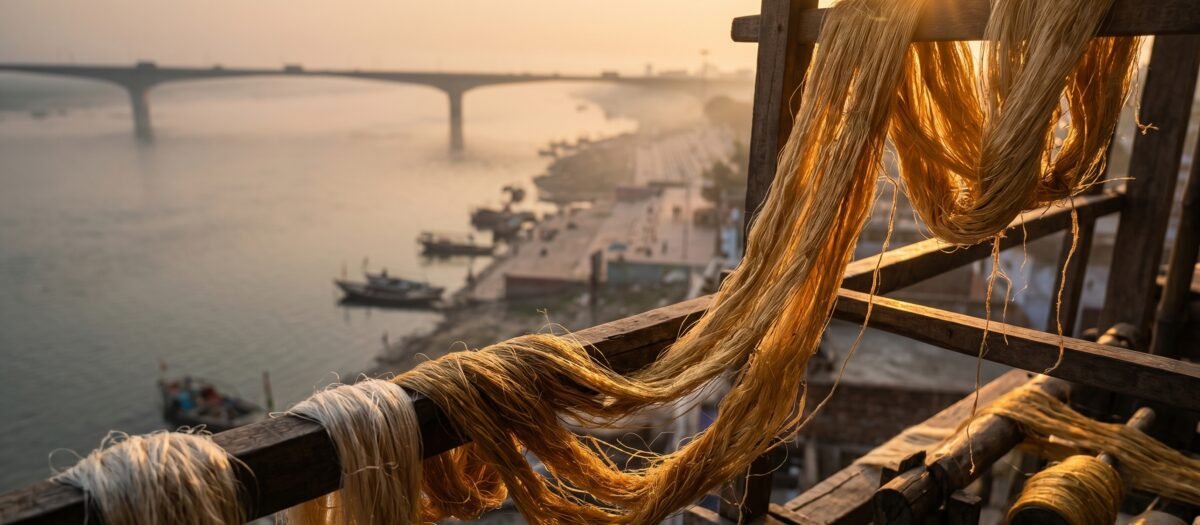
Bhagalpur — The Silk City of India: 200 Years of Heritage on the Banks of the Ganga
Most people in India have never heard of Bhagalpur. Most who have, only know one thing about it — the silk. But this city on the southern bank of the Ganga holds something deeper: an unbroken thread between the Mahabharata and the modern handloom, between ancient universities and living craft. This is the full story.

Sitting with a handloom owner in Nathnagar–Champanagar, Bhagalpur. The same neighbourhood has woven silk here for over two centuries.
- Where Bhagalpur sits — the Ganga, Bihar, and the ancient kingdom of Anga
- Bhagalpur 200 years ago — what the streets looked like in 1908
- The 200-year silk story — how Bhagalpur became the Silk City of India
- Why Bhagalpur silk is Tussar silk — the wild silkworm explained
- Nathnagar and Champanagar — inside the weaving cluster
- The numbers — 35,000 weavers, GI tag, 2 million metres a year
- Vikramshila — the ancient Buddhist university near Bhagalpur
- The ghats of the Ganga — Barari, Kuppa, and the river that built the city
- Maa Kali at Parbatti — the cultural soul of Bhagalpur
- The Vikramshila Gangetic Dolphin Sanctuary
- Modern Bhagalpur — Ghantaghar Chowk, the railway junction, the city today
- How to reach Bhagalpur and when to visit
- How to buy authentic Bhagalpur silk
1. Where Bhagalpur sits
Bhagalpur lies on the southern bank of the Ganga, about 220 kilometres east of Patna. It is the third-largest city in Bihar and the administrative headquarters of the Bhagalpur division. Most outsiders know nothing about it. That is the first thing worth correcting.
The land here was called Anga long before it was called Bhagalpur. In the Mahabharata, Anga is the kingdom gifted to Karna by Duryodhana — a real geographic territory in eastern Bihar with its capital at Champa, today’s Champanagar, now part of Bhagalpur city itself. The Ramayana mentions it. Buddhist texts describe it as one of the sixteen Mahajanapadas — the great states of ancient India. The name “Bhagalpur” itself is believed to come from “Bhagdatpuram” or “Bhagduttpuram” — the city of good fortune.

Barari Ghat — where the Ganga still defines the rhythm of Bhagalpur. The Vikramshila Setu bridge in the background.
The Ganga is not background scenery here. It is the reason this city exists. In the 7th century, when the Chinese travellers Hieun-tsang and Fa-Hien wrote about eastern India, they described Champa — the harbour at present-day Champanagar — as a serious trade centre. Boats and coins from the Middle East and the Far East have been excavated from sites along the river. Long before “Made in Bhagalpur” labels appeared on silk sarees, Bhagalpur was already a name on the trade map of the ancient world.
2. Bhagalpur, 200 years ago

Bhagalpur, around 1908. Horse carriages, mud roads, and colonial-era streets — the same city that today sits on the doorstep of high-speed trains.
This photograph is over a hundred years old. It shows a Bhagalpur most of us have never seen — but one that was already, even then, a meaningful trading town. The carriages, the small market stalls, the open ground that today has been built over by markets and houses. The skyline has changed. The looms have not.
If you walked the same lanes in 1808, then 1908, then 2026 — the most consistent sound you would hear, in every century, would be the rhythmic clack of a handloom from a weaver’s home. That is the through-line of Bhagalpur. Empires changed. Republics arrived. The looms kept going.
3. The 200-year silk story
How does a small Bihar city become known across the world for silk?
The official answer is: over 200 years of continuous handloom weaving in the Bhagalpur cluster, particularly in the seven sub-clusters around Nathnagar, Champanagar, Champapur, Khanjarpur, and surrounding villages. The Weavers Service Centre was established here in 1974 to formally support the industry. But the craft itself is far older — Bhagalpur was a textile centre during the medieval Mughal era, with silk from here reportedly favoured at Akbar’s court.
The deeper answer is geography and biology. Bhagalpur sits at the meeting point of three things the Tussar silkworm needs: Arjun and Asan trees (the host plants), a humid sub-tropical climate, and access to the Ganga’s transport network. The combination is rare. It made Bhagalpur the natural home of wild Tussar silk production in India.
4. Why Bhagalpur silk is Tussar silk
This is the part most people get wrong. They hear “Bhagalpuri silk” and assume it’s a brand. It is not. It is a type of silk — and the type is called Tussar.
Tussar silk comes from the cocoon of the wild silkworm Antheraea paphia, also called the Vanya silkworm. Unlike mulberry silk — where silkworms are farmed on cultivated mulberry leaves — Tussar silkworms live in the wild, feeding on Arjun (Terminalia arjuna) and Asan trees in the forests of Bihar, Jharkhand, Odisha, Madhya Pradesh, and West Bengal.
The result is a thread that is fundamentally different from regular silk:
- Naturally golden in colour — no dye needed for the base hue
- Textured, not perfectly smooth — slubby, with character
- More breathable — porous fibre, cooler than mulberry silk
- Stronger and more durable than most fine silks
- “Peace silk” friendly — many producers extract thread without killing the moth
This is why Bhagalpuri Tussar feels different the moment you touch it. It does not have the slippery shine of Banarasi or Kanjeevaram. It has a quiet, golden, almost earthy lustre. That is the wild silkworm signature.
5. Nathnagar and Champanagar — inside the weaving cluster
The Bhagalpur silk industry is not concentrated in factories. It is distributed across seven sub-clusters, with the largest activity in Nathnagar (about 4 km from Bhagalpur Junction) and the historic Champanagar. At any given time, around 300–400 looms are running across the city’s neighbourhoods, depending on order volume. The total number of looms registered in the cluster is far higher.
If you visit Nathnagar today, you will find weavers working in small front rooms of their own houses. The loom is built into the household. The work is generational — the father weaves, the son helps with the warp setup, the grandmother spins thread. Many of the families I met during my visits have been doing this for four, five, six generations.
This is why the Bhagalpur silk industry has survived where so many other Indian crafts have collapsed. It never industrialised. It stayed inside the home.
6. The numbers behind Bhagalpur silk
The Geographical Indication tag granted in 2013 is more than ceremonial. It legally protects the name “Bhagalpur silk” — meaning a fabric cannot be sold under that name unless it is genuinely produced in this geographic cluster. It is the same legal protection that Champagne and Darjeeling tea have. It exists to stop what was happening for decades — fake “Bhagalpuri” sarees being mass-produced in Surat and sold in Delhi.
7. Vikramshila — the ancient university near Bhagalpur

Vikramshila University ruins, photographed from above. Founded in the 8th century by King Dharmapala of the Pala dynasty.
About 50 kilometres east of Bhagalpur, in Antichak village, lie the brick remains of Vikramshila University — one of the two greatest learning centres of ancient India, alongside Nalanda. Founded by King Dharmapala of the Pala dynasty in the late 8th century, it operated for over 400 years before being destroyed during the invasions of Bakhtiyar Khilji around 1193 CE.

The central stupa structure at Vikramshila — the focal point of what was once a residential university with thousands of students.
At its peak, Vikramshila taught Tantric Buddhism, philosophy, grammar, metaphysics, and logic to students from across South Asia and Tibet. It was a residential university — students and teachers lived inside the campus you see in these photographs. Indian historians have argued for decades that Vikramshila has been overshadowed by Nalanda only because Nalanda is closer to Patna and easier to reach. The site itself, in scale and significance, was on the same level.
Today, very few Indians outside Bihar know it exists. Most travel guides barely mention it. That is part of what makes Bhagalpur worth taking seriously — the city is sitting on top of an under-recognised civilisational layer.
8. The ghats of the Ganga

Kuppa Ghat — the ashram of Maharshi Mehi Paramhans, a major centre of the Sant Mat spiritual tradition.
The Bhagalpur stretch of the Ganga has multiple ghats, each with its own meaning. Barari Ghat is the most prominent — a wide riverfront where the new Vikramshila Setu bridge now arches across to North Bihar. It is also a working ghat: people bathe, fishermen launch boats, and small daily trade still happens at the water’s edge.
Kuppa Ghat is quieter. It is the home of the ashram of Maharshi Mehi Paramhans, one of the most important figures of the Sant Mat tradition — a spiritual movement with roots going back to the 13th century, focused on inner experience, meditation, and the sound current. People come here from across India and abroad. Most of Bhagalpur barely talks about it.
This is the pattern with Bhagalpur. The city has things that, anywhere else in India, would be flagship tourist sites. Here, they are just part of the everyday.
9. Maa Kali at Parbatti — the cultural soul

Maa Kali at Parbatti, Bhagalpur — among the most elaborately decorated Kali idols in eastern Bihar during Kali Puja.
The cultural identity of Bhagalpur is layered. It is Hindu — Kali Puja at Parbatti, Durga Puja across the city, and the major festival cycle of the Anga region. It is Sufi — the Khanqah-e-Shahbazia, founded in 1577 CE, is one of the most revered shrines in the city, with a black-domed mosque next to it that may be the oldest in Bhagalpur. It is Jain — Champapur Digambar Jain Siddha Kshetra near Nath Nagar marks the birthplace of Vasupujya, the 12th Tirthankara.
And it is also distinctively Angika. The Angika language — a recognised regional language of the Anga belt — has its own literature, its own oral storytelling tradition, and its own claim to cultural identity that is separate from “generic Bihari.” The local art form, Manjusha Art, is a serpentine ritual painting style with mythological roots that pre-date most other folk traditions of Bihar.
10. Vikramshila Gangetic Dolphin Sanctuary

Greater Adjutant — one of the rare bird species spotted in and around the Vikramshila Gangetic Dolphin Sanctuary.
The 50-kilometre stretch of the Ganga between Sultanganj and Kahalgaon, near Bhagalpur, is home to the Vikramshila Gangetic Dolphin Sanctuary — the only protected habitat in India for the Gangetic Dolphin, the National Aquatic Animal of India. At dawn, if you stand on the right ghat, you can actually see them surfacing.
The sanctuary is also a critical bird zone. The Greater Adjutant — one of the rarest large storks in the world, with fewer than 1,200 mature individuals globally — has been recorded in this region. The wetlands here are part of the broader Gangetic ecosystem that conservationists worldwide are trying to protect. Most Indians have no idea this is in their backyard.
11. Modern Bhagalpur — the city today

Ghantaghar Chowk — the historic clock tower at the centre of old Bhagalpur, lit in the national tricolour.
If you want to feel the pulse of present-day Bhagalpur, walk through Ghantaghar Chowk in the evening. The clock tower at the centre is the de-facto landmark of the old city — locals give directions using it the way Mumbaikars use Bandstand or Delhi people use CP. Around it, you have the city’s oldest markets, sweet shops that have run for three generations, and tea stalls that have heard every political opinion in Bihar.


Bhagalpur Junction — daytime arrivals and the late-night platform. The signboard is written in Hindi, English and Urdu — a quiet reminder of the layered cultural history of the city.
Bhagalpur Junction is the city’s main artery. Direct trains connect it to Patna, Kolkata, Delhi, and Mumbai. The Vikramshila Express from New Delhi is the most well-known long-distance service. The station is busy day and night — pilgrims, traders, students, weavers carrying packed bundles of silk to ship out, NRIs visiting parents during festival season.
12. How to reach Bhagalpur and when to visit
By train — the most reliable way. Bhagalpur Junction is well connected. From Patna, the Vikramshila Express takes around 3 hours.
By road — about 220 km from Patna, NH-31. Around 5–6 hours by road depending on traffic.
By air — Bhagalpur does not have its own airport. The nearest is Patna (Jay Prakash Narayan International Airport), then a train or taxi onward.
Best time to visit — October to March. The winter months are pleasant and dry, ideal for walking through old neighbourhoods, the weaving clusters, the ghats, and Vikramshila. Summers are hot. Monsoon brings heavy rain and flooded streets in parts of the old city.
13. How to buy authentic Bhagalpur silk
If you came to this article looking for silk, here is the practical part. There are three reliable ways to buy genuine Bhagalpuri Tussar:
1. Buy in Bhagalpur directly. The shops and showrooms in Nathnagar, the main bazaar near Ghantaghar, and the Bihar State Handloom Emporium all carry verified product. Prices are fair because there is no middleman markup.
2. Buy from GI-tag verified online sellers. Look for the GI tag, look for “100% pure Tussar silk” specifically, and check whether the listing names the weaver or the cluster. Generic “Bhagalpuri silk saree” listings on big marketplaces are often blended polyester.
3. Buy from heritage stores. Stores like Taneira (Tata group) and a handful of curated boutiques carry genuine certified Bhagalpur silk with full traceability.
The closing word
Bhagalpur is not waiting for the world to discover it. The looms in Nathnagar will keep clacking whether or not anyone outside Bihar is listening. The Ganga at Barari will keep flowing whether or not the Gangetic dolphin gets a documentary. Vikramshila will keep standing in red brick whether or not it ever gets the global recognition Nalanda gets.
But you should know it exists. Because some places carry their history quietly — and Bhagalpur is one of them.
“Bhagalpur is one of those cities where the past has not been turned into a museum. It is still the present, just running on a slower clock.”
Stories from the Loom
Get thoughtful articles about Bhagalpur, the silk city, and the craft heritage of the Anga region delivered to your inbox. Read more from the journal →