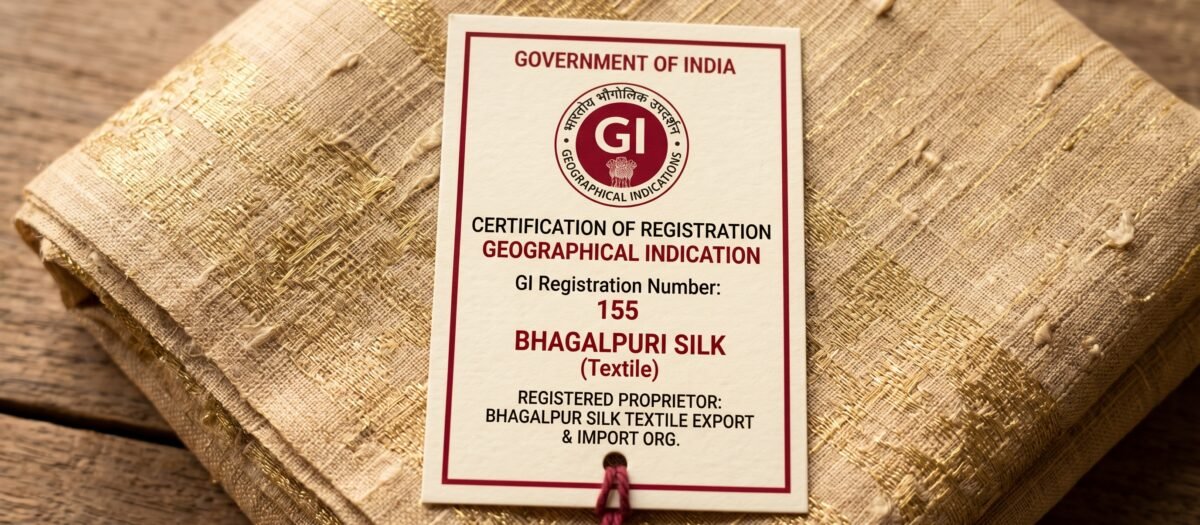
In 2008, a small cream-and-crimson certificate changed the fate of an entire city’s craft. Bhagalpur’s silk weavers — who had been spinning extraordinary cloth for over two centuries — finally had official proof that their work was theirs alone.
You may have seen the letters GI stamped on a silk saree label and moved on. But behind those two letters lies a decades-long fight for recognition, a legal shield against counterfeits, and a quiet revolution in how the world understands handcrafted Indian textiles. For Bhagalpuri silk — also known as Angika silk or Bhagalpur Tussar silk — the GI tag is not a marketing badge. It is a matter of survival.
This is the full story of the Bhagalpuri silk GI tag: what it means legally, what it protects practically, and why every buyer of authentic handloom silk in India needs to understand it before they shop.
What Is a GI Tag? The Legal Foundation
A Geographical Indication tag, commonly called a GI tag, is a certification granted under India’s Geographical Indications of Goods (Registration and Protection) Act, 1999. It identifies a product as originating from a specific geographic region, where a particular quality, reputation, or characteristic is essentially attributable to that origin and no other.
The concept is not unique to India. France protects Champagne wine, Italy protects Parmigiano-Reggiano cheese, and Scotland protects Scotch whisky — all through geographical indication laws. In India, Darjeeling tea was the first product to receive a GI tag. Since then, over 600 Indian products have followed, spanning food, textiles, handicrafts, and agricultural produce. Bhagalpuri silk, registered as GI Number 155 in the textile category, stands among the country’s most culturally significant protected crafts.
- GI Registration Number: 155
- Product Category: Textile — Silk
- Registered Name: Bhagalpuri Silk
- Registered Proprietor: Bhagalpur Silk Textile Export & Import Organisation
- Protected Geographic Area: Bhagalpur and surrounding districts, Bihar, India
- Year of Registration: 2008
- Governing Law: GI of Goods (Registration & Protection) Act, 1999
Why Only Bhagalpur? The Geography Behind the Craft
The GI tag for Bhagalpuri Tussar silk is not arbitrary. The geographical specificity is the entire point. Bhagalpur, situated along the banks of the Ganga in eastern Bihar, has a unique combination of climate, forest cover, and generational craft knowledge that cannot be replicated elsewhere. The city has been known as the Silk City of India for centuries — a name rooted in both the scale of its weaving industry and the singular quality of the fabric it produces.
The silk produced here is predominantly Tussar silk (also spelled Tasar silk), derived from the cocoons of Antheraea mylitta silkworms. Unlike the white mulberry silk produced in Karnataka or West Bengal, Bhagalpur Tussar silkworms feed on wild Arjun, Saja, and Asan trees found in the forests of Jharkhand and Bihar. This wild diet is what gives Bhagalpuri Tussar its characteristic natural golden-amber colour, its textured surface, and its distinctive matte sheen — properties that no synthetic dyeing or processing technique can authentically reproduce.
Beyond the raw material, Bhagalpur’s 30,000-plus weaver families carry forward a weaving tradition that is at least 2,000 years old. The katia spinning technique, the traditional handloom setups of Nathnagar and Champa Nagar, and the intricate motif vocabulary drawn from Anga region’s folk art — these are knowledge systems embedded in families across generations. You cannot license or transfer them. They exist in Bhagalpur, and the GI tag says so, legally.

“The GI tag does not create the quality of Bhagalpuri silk. It simply tells the world that this quality exists — and that it can only come from here.”
— Angika Silk
What the GI Tag Actually Protects
Before the GI registration was granted in 2008, the name “Bhagalpuri silk” was essentially an open label. Power-loom mills in Surat, synthetic fabric manufacturers in Gujarat, and even overseas factories were selling machine-woven imitations under the Bhagalpuri name — at a fraction of the cost and with none of the craft. Genuine handloom weavers in Bhagalpur found themselves undercut at every price point. Buyers had no reliable way to distinguish authentic GI Bhagalpuri silk from cheap imitations.
The GI tag fundamentally changed this dynamic. It introduced legal teeth into a conversation that had previously been entirely market-driven. Here is precisely what the GI certification now protects:
- Only silk produced in the designated Bhagalpur region can legally carry the GI certification label. Any other product using the name is in violation of Indian law.
- Unauthorised use of the GI-protected name “Bhagalpuri Silk” is a criminal offence under the GI Act, punishable by imprisonment of up to three years and a fine of up to ₹2 lakhs.
- Buyers can verify authenticity directly through the GI tag number and the registered proprietor details — creating a traceable chain of origin.
- Weavers and weaver cooperatives in Bhagalpur gain formal legal standing to challenge counterfeit products in court and file complaints with GI authorities.
- Registered exporters of Bhagalpuri Tussar silk can command a documented price premium in international markets, particularly in the EU, USA, and Japan, where certified-origin textiles carry significant buyer preference.
Years of weaving tradition
Weaver families in Bhagalpur
GI Registration Number
The Human Side — What It Means for Weavers
Statistics tell one part of the story. The harder truth to understand is what the GI tag means to the women and men who sit at handlooms in narrow workshops, working 10 to 12 hours a day to produce a single metre of Bhagalpur handloom silk.
For them, the GI tag is recognition. It is the government — and by extension, the market — saying: your skill is real, your origin matters, and your work cannot be replicated by a machine in a factory in another state. In a country where handloom weavers have faced decades of displacement by power-loom competition, that recognition carries weight beyond the legal certificate.

In practical terms, the GI tag has opened access to government schemes under the Ministry of Textiles, export promotion programmes through the Export Promotion Council for Handicrafts (EPCH), and preferential access to trade fairs targeting international buyers. It has also made Bhagalpuri Tussar silk eligible for the Silk Mark certification — India’s quality assurance label for pure silk — creating a double layer of consumer protection.
How to Identify Authentic GI-Tagged Bhagalpuri Silk
Knowing that the GI tag exists is step one. Knowing how to use it when you are actually buying Bhagalpuri silk — whether at a weaver’s workshop, a government emporium, or an online marketplace — is step two. Here is a practical checklist:
- Look for the official GI tag label physically attached to the fabric or saree — it should not merely be printed text on the packaging or a digital stamp on a website listing.
- The authentic tag references GI Registration Number 155 and identifies the product as “Bhagalpuri Silk” under the textile category.
- Genuine Bhagalpuri Tussar has a natural, slightly uneven texture with visible slubs — this is a feature, not a defect. Machine-made imitations are too uniform and regular in surface.
- Authentic Bhagalpur Tussar silk has a warm matte-golden or amber sheen. A high-gloss, bright shine almost always indicates synthetic or blended fabric.
- When buying online, look for sellers who specify handloom origin, weaver cooperative sourcing, or GI-certified stock. Vague descriptions like “Bhagalpuri style” are a warning sign.
- Price is a reliable signal — genuine GI-certified handloom Tussar silk from Bhagalpur cannot honestly be priced below ₹800–1,200 per metre. Anything significantly cheaper is almost certainly not the real product.
GI Tags and the Future of India’s Handloom Heritage
India has over 600 registered GI products today. Textiles form one of the largest and most culturally significant categories — from Pochampalli Ikat in Telangana to Chanderi weaves in Madhya Pradesh, from Kashmir Pashmina to Kanchipuram silk sarees. Each GI tag represents not just a product but a community, a geography, and a knowledge system that took centuries to develop and could disappear in a generation without active protection.
Bhagalpuri silk’s GI status places it in this same constellation of protected Indian crafts. But legal protection alone is not enough. The tag only works if buyers understand what it means and choose to support it with their purchasing decisions. Every time a buyer insists on GI-certified Bhagalpur Tussar silk over a cheaper imitation, they are directly sustaining the livelihoods of weaver families in Bihar who have no other form of economic protection.
The global market for authentic, traceable, ethically produced textiles is growing — driven by conscious consumers in India, the NRI diaspora, and international buyers who want craft with a story. Bhagalpuri silk, with its 2,000-year heritage, its wild-forest silkworms, its GI certification, and its 30,000 weaver families, is precisely that story. The GI tag is the proof.
“To wear GI-tagged Bhagalpuri silk is to wear a piece of a place — the Ganga plains, the forest silkworms, and the hands of Bhagalpur are all woven into every thread.”
— Angika Silk
The next time you hold a piece of Bhagalpuri Tussar silk — feel its natural weight, notice the irregular golden sheen, trace the texture with your finger — remember that a small cream-and-crimson certificate stands behind it. A certificate that says: this is the real thing, and there is no other.
Exploring Bhagalpur’s silk heritage? Read our full archive of stories on craft, culture, and the weavers behind the weave.