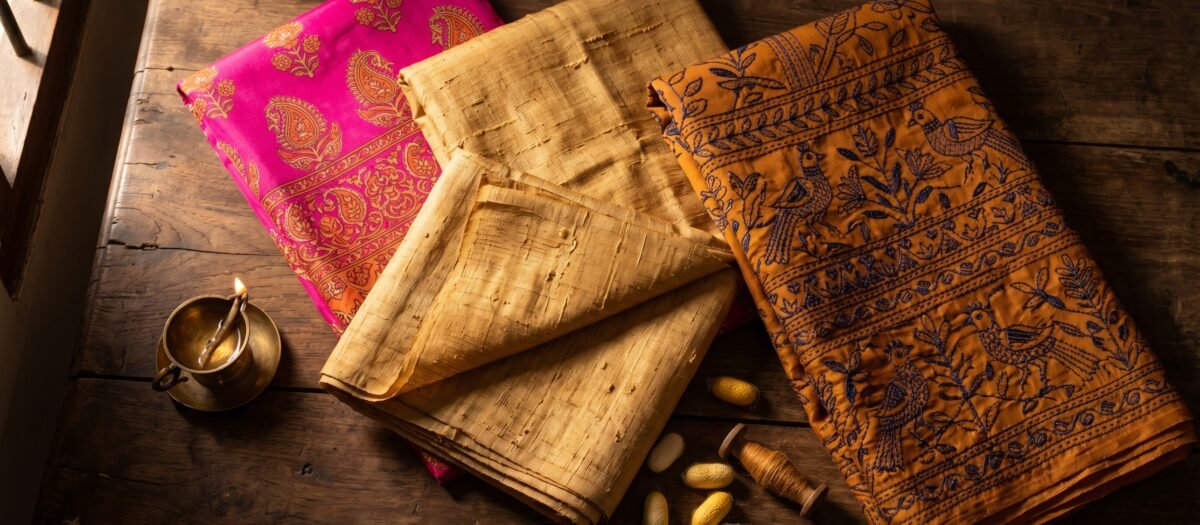
You’re looking at a saree labelled “Bhagalpuri silk” — priced at ₹1,800 on one website, ₹12,000 on another, and ₹35,000 at a heritage boutique. Same words. Three completely different products. Which one is real? And which price is fair?
This guide answers exactly that — with real price ranges sourced from weavers, verified online retailers, and B2B export data. No marketing fluff. Just the honest numbers, and what they actually mean.
• Machine-made / art silk: ₹800 – ₹5,000
• Semi-handloom (mixed process): ₹3,000 – ₹9,000
• Pure handloom Tussar (authentic): ₹10,000 – ₹20,000
• Master weaver / natural dye / hand-painted: ₹20,000 – ₹75,000+
• Collector-grade / export heritage pieces: ₹75,000 – ₹1,50,000
First: Why “Bhagalpuri Silk” Doesn’t Always Mean the Same Thing
Bhagalpur holds a Geographical Indication (GI) tag for its Tussar silk — India’s official recognition that this weave is a protected heritage product tied to this specific city in Bihar. But GI tags apply to the raw silk fabric, not to every saree sold under the “Bhagalpuri” label.
Walk through Surat’s wholesale markets, scroll Amazon, or check any fast-fashion site — and you’ll find hundreds of sarees called “Bhagalpuri” that were never within 1,000 kilometres of Bhagalpur. They use art silk (synthetic), viscose blends, or power-loom replicas of traditional patterns. They are not fraudulent in the criminal sense — but they are not what you think you’re buying.
Understanding this distinction is the single most important thing a buyer can know. And it explains everything about price.
The 5 Tiers of Bhagalpuri Silk Sarees (With Real Prices)
Tier 1 — Machine-Made / Art Silk / Power-Loom Printed
| Price Range | ₹800 – ₹5,000 |
| Wholesale (B2B) | ₹200 – ₹2,000 per piece |
| Fabric | Art silk, viscose, polyester blend, or synthetic “silk-look” yarn |
| Made in | Surat (Gujarat), mostly power-loom factories |
| Where sold | Meesho, Amazon, Flipkart, wholesale catalogs |
This is the majority of what you see online priced under ₹3,000. The sarees look bright, have bold printed patterns, and photograph well. But they are made on electric power-looms — often in Surat — using synthetic or blended yarn.
These are not Bhagalpuri silk in any traditional sense. No tussar cocoon touched them. No Bhagalpur weaver’s hands wove them. They simply use designs inspired by Bhagalpuri patterns.
They are perfectly fine for casual wear if you know what you’re buying. The problem arises when they are sold at ₹3,500–₹5,000 with claims like “pure Bhagalpuri silk” — which is misleading at best.
Red flags for this tier:
- Price below ₹3,000 for a “pure silk” claim
- Perfectly uniform weave — no variation whatsoever
- Printed patterns (not woven-in) — print sits on top of fabric
- No Silk Mark, no Handloom Mark, no weaver information
- Burns with a plastic smell, leaves a hard bead
Tier 2 — Semi-Handloom / Ghicha Silk / Mixed Process
| Price Range | ₹3,000 – ₹9,000 |
| Fabric | Ghicha silk, Tussar-cotton blends, semi-handloom Tussar |
| Made in | Bhagalpur (partially), also Jharkhand and Bengal |
| Where sold | Linen World, specialty saree stores, some Etsy sellers |
This tier includes Ghicha silk — the by-product of Tussar silk production, made from shorter, broken filaments of the Tussar cocoon. It has a rougher texture, natural golden hue, and visible slubs. It is genuinely handwoven in many cases, but uses a lower grade of the raw material.
Tussar-cotton blends are also common here — woven on pit looms or frame looms in Bhagalpur, they combine breathability with silk’s natural sheen. These are good everyday sarees that carry real artisan involvement at a more accessible price.
Verified market prices: Linen World lists handwoven Ghicha Tussar sarees at ₹3,899–₹5,499. Some semi-handloom Tussar pieces from verified sellers range ₹4,000–₹8,990 (Linen World data).
Who should buy here: Buyers who want genuine Bhagalpur weaving involvement at a budget below ₹10,000. Good for festive wear, daily use, or gifting.
Tier 3 — Pure Handloom Tussar Silk (The Authentic Product)
| Price Range | ₹10,000 – ₹20,000 |
| Fabric | 100% pure Tussar silk (Desi Tussar / Katiya Tussar) |
| Made in | Bhagalpur, Bihar — pit loom or frame loom, by skilled weavers |
| Certifications | Silk Mark, Handloom Mark, GI Tag documentation available |
| Where sold | Mavuri’s, Indiahandmade, Taneira (TATA), direct weaver cooperatives |

This is where genuine Bhagalpuri Tussar silk begins. A pure handloom Tussar saree takes 3 to 7 days for a skilled weaver to complete on a pit loom. The raw material — Tussar cocoons from Antheraea paphia silkworms that feed on Arjun, Sal, and Saja trees — is processed through degumming, reeling, and dyeing before weaving even begins.
Real market prices we found:
- Mavuri’s pure handloom Bhagalpuri silk: ₹10,486 – ₹17,686 (verified listings)
- Indiahandmade GI-tagged pure Desi Tussar: verified handwoven, prices in this range
- Taneira (TATA) Bhagalpuri collection: premium pricing, ₹12,000+
The natural characteristics of genuine Tussar in this tier:
- Natural golden/amber hue — the silk’s inherent color before any dyeing
- Visible slubs — tiny thicker sections in the yarn, a natural byproduct of hand-reeling
- Slight weave irregularities — not flaws, but the signature of human hands
- Burn test: burns slowly, smells like human hair, leaves brittle ash — not plastic
- The scroop effect: a soft rustling sound when the silk moves
- Warmth to touch: rub gently — real silk warms up; synthetics stay cold
Who should buy here: Serious buyers who want the real thing — for festivals, weddings, heirloom gifting, or personal investment in Indian craft heritage.
Tier 4 — Master Weaver / Natural Dye / Hand-Painted (Premium Artisan)
| Price Range | ₹20,000 – ₹75,000 |
| Fabric | Pure Tussar silk with natural/vegetable dyes |
| Craft | Kantha embroidery, Madhubani hand-painting, Shibori resist-dyeing, Zari work by master craftsmen |
| Time to make | 2 weeks to 3 months per piece |
| Certifications | Silk Mark Certified (required at this tier), often Craftmark too |
| Where sold | Shobitam (Silk Mark certified), Bhasha Bharat, direct artisan studios, Craft exhibitions (Dilli Haat, Surajkund) |
This is where Bhagalpuri silk crosses from clothing into art. A Kantha-embroidered Tussar saree — where every stitch is hand-sewn by a single artisan — can take 6 to 12 weeks of uninterrupted work. A Madhubani hand-painted Tussar saree requires a painter skilled in the folk tradition to cover six yards of silk with story-motifs using natural colours derived from plants, minerals, and earths.

Right: Synthetic reactive-dyed silk — uniform harsh red, plastic sheen, machine-perfect weave.
Natural dyeing adds significant cost and effort. Unlike synthetic reactive dyes (used in Tier 1 and 2), natural dyes from indigo, turmeric, pomegranate rind, harda, and madder require multiple mordanting baths, extended soaking, and careful sun-exposure processes. Colours are subtler, more complex, and deepen beautifully over years of wear.
What justifies the price:
- The weaver earns a living wage — not a sweatshop piece rate
- Natural dye materials and their preparation cost significantly more than synthetic dyes
- Kantha hand-embroidery: one skilled woman, 2–3 months, tens of thousands of stitches
- Madhubani painting: trained folk artists, not digital prints
- Each piece is one-of-a-kind — no two identical
Shobitam lists Silk Mark certified Tussar Madhubani hand-painted sarees in this category. Bhasha Bharat and similar heritage platforms source from Bhagalpur artisans directly. General price band observed: ₹20,000 to ₹75,000 depending on the complexity of the work.
Tier 5 — Collector Grade / Export Heritage / Commissioned Pieces
| Price Range | ₹75,000 – ₹1,50,000+ |
| Fabric | Pure Desi/Katiya Tussar, sometimes Kosa silk |
| Craft | Multi-technique: handloom base + Kantha + hand-painting + silver/real zari |
| Time to make | 3–6 months per piece |
| Buyers | Collectors, high-end boutiques, international fashion buyers (Paris, Milan), museum acquisitions |
| Export pricing | $45–$65+ FOB (B2B export price — retail 3–5x higher) |
Bhagalpuri silk has reached the design studios of Paris and Milan. International buyers source directly from Bhagalpur cooperatives and master weavers for exclusive collections. At this tier, a saree is genuinely an heirloom object — wearable, inheritable, and culturally significant.
Pieces combining real silver zari (not the brass imitation most Tier 1–2 sarees use), full-body Kantha work on hand-woven Tussar with natural indigo and madder dyes, and Madhubani painting on the pallu — these involve 4–6 craftspeople and months of work. ₹1,00,000 for such a piece is not an inflated price — it is the actual cost of that much human skill and time.
B2B export data confirms: premium handloom-exclusive Bhagalpuri pieces are exported at $45+ FOB per piece, which at Indian retail markup translates to ₹75,000–₹1,50,000+ at heritage boutiques.
Side-by-Side Comparison: What You Get at Each Price Point
| Price Range | Fabric | Handmade? | From Bhagalpur? | Worth It? |
|---|---|---|---|---|
| ₹800–₹3,000 | Art silk / polyester | ❌ Machine | ❌ Usually Surat | Only if you know what it is |
| ₹3,000–₹9,000 | Ghicha / Tussar-cotton | ✅ Partially | ✅ Often | Good value for everyday |
| ₹10,000–₹20,000 | Pure Tussar silk | ✅ Yes | ✅ Yes | Best all-round buy |
| ₹20,000–₹75,000 | Pure Tussar + craft | ✅ Fully | ✅ Yes | Exceptional for heirloom |
| ₹75,000–₹1,50,000+ | Collector grade | ✅ Multi-artisan | ✅ Yes | Investment / collector piece |
How to Verify Before You Buy
The 5-Second Burn Test (Do This at Home)
Pull a loose thread from an inconspicuous edge. Burn it with a lighter.
- Real Tussar silk: Burns slowly, curls away from flame, smells like burning human hair, leaves a brittle dark ash that crumbles easily
- Synthetic / art silk: Burns fast, melts, smells like burning plastic, leaves a hard bead you can’t crush

The Warmth Test
Rub the fabric briskly between your palms for 10 seconds. Real silk produces warmth — you’ll feel it. Synthetics stay cool or feel slightly slippery.
Check the Back of the Saree
Flip the saree over and examine a motif from behind. On genuine handloom sarees, the reverse shows neat thread changes and small organic knots — evidence of the weaver’s shuttle movements. Power-loom sarees have too-perfect uniformity or clipped, prickly thread ends.
Look for Certifications
- Silk Mark: Issued by Silk Mark Organisation of India — guarantees 100% pure natural silk (but not handloom)
- Handloom Mark: Guarantees handwoven fabric — but not necessarily pure silk
- Both together: Best confirmation of genuine handloom pure silk
- GI Tag documentation: Ask the seller — if they can’t show it for a ₹15,000+ piece, that’s a concern
Ask the Seller Three Questions
- Which loom type — pit loom, frame loom, or power loom?
- Can you tell me the weaver’s name or cooperative?
- Is this Desi Tussar (wild silk) or cultivated mulberry silk?
An honest seller answers confidently. An evasive seller is a signal.
Why Cheap “Bhagalpuri Silk” Is Not a Bargain
A saree sold at ₹1,800 with “pure Bhagalpuri silk” in the title is not a deal — it is a different product with a misleading name. You are not getting the same thing at a lower price. You are getting a different thing.
Consider the math: a genuine Bhagalpuri weaver in 2026 earns approximately ₹400–₹600 per day. A pure handloom Tussar saree takes 4–7 days. That’s ₹1,600–₹4,200 in labour alone — before raw material, dyeing, finishing, or seller margin. A ₹1,800 “Bhagalpuri silk” saree cannot contain that weaver’s work. It simply cannot.
Buying at ₹1,800 and believing it’s handmade harms real artisans by suppressing what customers are willing to pay for their actual, months-of-skill work.
The Natural Dye Difference — Why It Costs More and Matters
Synthetic dyes are cheap, fast, and produce vivid colours. Natural dyes — indigo, turmeric, pomegranate, harda, madder, lac — require:
- Sourcing and preparation of the dye material
- Mordanting: treating the silk fibre with alum or iron so colour bonds properly
- Multiple dye baths and extended soaking times
- Sun-exposure to set the colour
- Skilled dyer knowledge passed through generations
Natural-dyed Tussar sarees age differently — the colours soften and deepen rather than fade into paleness. They are gentler on skin. And they are genuinely sustainable — no synthetic chemistry discharged into Bhagalpur’s rivers.
A saree with natural dye + handloom Tussar starts at ₹15,000 and goes higher depending on complexity. If someone sells it cheaper than that with both claims intact — be skeptical.
Where to Buy — Our Honest Guidance
For pure handloom Tussar (₹10,000–₹20,000 tier):
- Indiahandmade.com — verified weavers, GI-tagged pieces
- Taneira (TATA) — quality assured, brick-and-mortar verification possible
- Mavuri’s — curated handloom collection with verified Bhagalpur sourcing
- Weaver cooperatives in Bhagalpur directly (if you’re here — come see us)
For premium / natural dye / hand-painted (₹20,000+):
- Shobitam — Silk Mark certified, Madhubani and Kantha Tussar collection
- Bhasha Bharat — artisan-direct, hand-painted Bhagalpuri
- Dilli Haat, Surajkund Mela, and national craft exhibitions — best source for meeting actual Bhagalpur weavers
Avoid: Any saree priced under ₹5,000 claiming to be “pure handmade Bhagalpuri silk” on Amazon, Meesho, or bulk wholesale platforms — unless it is explicitly and certifiably a Ghicha or cotton-silk blend, in which case ₹3,000–₹6,000 is reasonable.
Frequently Asked Questions
Is a ₹2,000 Bhagalpuri saree fake?
Not fake — just not pure handloom Tussar silk. It is almost certainly a machine-made art silk or printed synthetic saree inspired by Bhagalpuri designs. It may look similar at first glance but is a fundamentally different product. If you buy it knowing that, fine. If you’re buying it thinking it’s handmade — you’re being misled.
What is the minimum price for a genuinely handmade Bhagalpuri Tussar saree?
Based on ground research: ₹10,000 is the realistic floor for a pure handloom Tussar saree with proper weaver involvement. Anything lower at the “pure handloom” claim is economically impossible to sustain for the artisan. Ghicha or semi-handloom can start around ₹4,000–₹5,000 and that can be legitimate.
How much should I pay for a natural-dye Bhagalpuri saree?
Expect ₹15,000 at minimum for genuine natural dye on handloom Tussar. With Kantha embroidery or Madhubani hand-painting added, ₹25,000–₹75,000 is the honest range.
Does the GI tag guarantee authenticity?
The GI tag protects the geographical origin claim — but it cannot be checked on every single retail transaction. Always combine with Silk Mark certification, seller reputation, and your own sensory checks (burn test, warmth test, texture inspection).
Can I visit Bhagalpur weavers directly?
Yes — and this is the best way to buy at fair prices while knowing exactly who made your saree. The Nathnagar area of Bhagalpur is where most Tussar processing and weaving happens. The Bhagalpur Silk Industry cooperative can also connect buyers with verified weavers. We’re based here — feel free to contact us for guidance.
The Bottom Line
Bhagalpuri silk saree prices span an enormous range — ₹800 to ₹1,50,000 — because they describe five completely different product categories. Most of what is sold cheaply online is not Bhagalpuri silk in any meaningful sense.
If you want the real thing:
- Budget under ₹9,000 → look for genuine Ghicha or Tussar-cotton from verified sellers
- Budget ₹10,000–₹20,000 → this is where authentic pure handloom Tussar begins
- Budget ₹20,000+ → you are entering master craft territory, and every rupee reflects real human skill
Bhagalpur’s weavers have preserved this craft for over 200 years. Knowing what you’re actually paying for — and choosing accordingly — is one of the most direct ways to support them.
📖 Want to know more about how Bhagalpuri silk is actually made?
Read our detailed history: The Story of Bhagalpuri Silk — 200 Years of the Silk City — we trace the craft from Mughal courts to your wardrobe.