
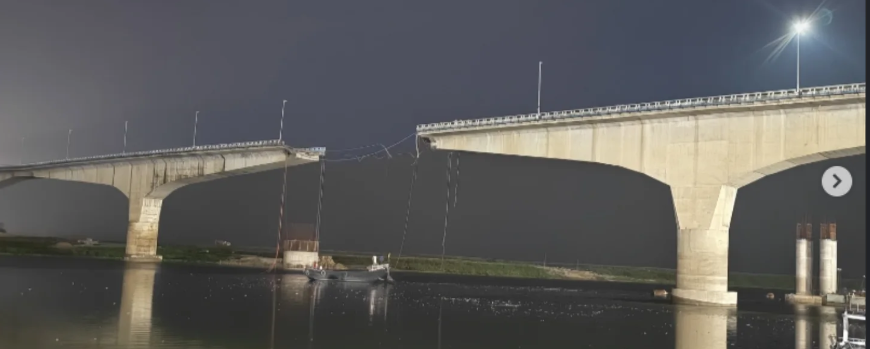
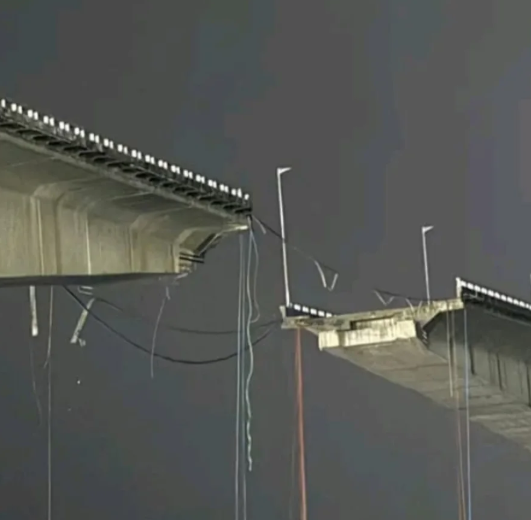
In the early hours of May 4, 2026, a 33-metre section of the Vikramshila Setu — Bihar’s longest bridge over the Ganga — broke off and fell into the river near Pillar 133. The collapse severed the only direct road link between Bhagalpur in south Bihar and the Seemanchal region in the north. No lives were lost. But the questions left behind are harder to bury than the bridge itself.
This post covers everything — why Vikramshila Setu was built, what warnings were ignored for years, exactly how the collapse unfolded, and what it means for the people of Bhagalpur and beyond.
Why Was Vikramshila Setu Built? The Story Behind Bihar’s Longest Bridge
Before 2001, crossing the Ganga between Bhagalpur and Naugachhia meant depending entirely on boats and steamers. The vast width of the river at this stretch — one of the widest in Bihar — left communities on the north bank effectively cut off from the district mainland for decades.
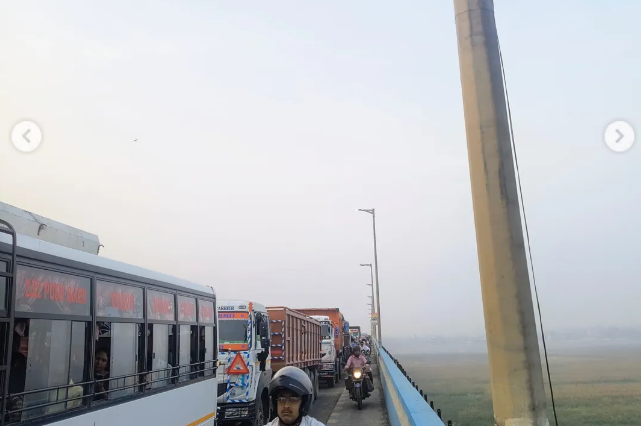
Vikramshila Setu changed that. The bridge stretches 4.7 kilometres, connecting Barari Ghat on the south bank (Bhagalpur side) to Naugachhia on the north bank. It links National Highway 33 and NH 31, dramatically reducing travel distances to Purnia and Katihar. At peak capacity, it carried over one lakh people and thousands of vehicles daily.
It was named after the ancient Vikramashila Mahavihara — the great Buddhist university founded by King Dharmapala between 783 and 820 AD — a nod to Bhagalpur’s deep historical identity. The bridge was inaugurated in 2001 by then Chief Minister Rabri Devi and constructed by the UP Bridge Corporation.
In short: this was not just infrastructure. For over two decades, Vikramshila Setu was the lifeline of an entire region.
“It serves as the only direct link between Bihar’s Bhagalpur district and the Seemanchal region and North Bengal.”
Bhagalpur’s identity runs deep — from its ancient Buddhist legacy to its silk heritage. If you want to understand what makes this city truly special, read our full guide: Bhagalpur — India’s Most Underrated Ancient City: Heritage, Rarity & the Ganga Vibe That Sets It Apart.
Built for a Different Era: The Capacity Crisis That Started Immediately
Vikramshila Setu was built as a two-lane bridge for a region that already needed far more. Within years of its 2001 opening, congestion was a daily reality. Demand for a parallel bridge began almost immediately.
The choice to award construction to the UP Bridge Corporation — despite the bridge being in Bihar — created a jurisdictional gap that haunted maintenance accountability for over two decades. Questions were raised even at the time about whether oversight of such a critical structure would ever be clear-cut.
To make matters worse, the Aguwani-Sultanganj Ganga Bridge — built nearby as an alternative route — saw three separate partial collapses during construction itself: in April 2022, June 2023, and August 2024. That is three consecutive years of failures on a bridge that hadn’t even opened yet. This is not the story of one unlucky bridge. This is a pattern pointing to systemic infrastructure failure in the region.
Opposition parties have consistently alleged negligence and corruption in the bridge’s upkeep. Engineers and residents point to a deeper question: were the materials, technical standards, and inspection systems ever robust enough to begin with?
Eight Years Without Major Repairs: A Timeline of Neglect
The collapse of Vikramshila Setu did not happen overnight. It was the result of years of missed warnings, cosmetic repairs, and no serious structural intervention.
- No major maintenance was carried out on the bridge in the eight years prior to the collapse.
- The bridge underwent three rounds of repairs over the past decade — yet structural damage kept recurring, raising legitimate questions about whether these were genuine fixes or merely cosmetic patches to secure budget approvals.
- A technical assessment after earlier damage identified problems with the bridge’s ball-bearings — yet officials later admitted they had no expectation that collapse was imminent.
- In March 2025, the concrete jacket around one of the pillars crumbled. These jackets are built specifically to protect pillars from steamer and boat collisions — their failure is a critical warning sign.
- The protection wall for Pillar 133 collapsed nearly a month before the final collapse. Residents believe that emergency repair work at that point could have saved the structure entirely.
- Overloaded commercial vehicles used this bridge as a primary freight route for over twenty years, with no weight enforcement mechanism ever put in place.
The final bitter irony: maintenance work on the bridge was completed in March 2026 — just weeks before the collapse. What exactly that money went into remains unanswered.
A foundation stone for a parallel 4-lane bridge was laid by PM Modi on September 21, 2020 — nearly 19 years after the original bridge opened. That single fact tells the story of how long the capacity and safety crisis was simply ignored.
Bhagalpur’s resilience runs through its culture and craft, not just its bridges. Explore its world-famous silk tradition: Bhagalpur Tussar Silk — History & Heritage.
May 4, 2026: How the Vikramshila Setu Collapse Unfolded — Minute by Minute
The night of May 4, 2026 began like any other at the bridge. But by midnight, it would change permanently.
| Time | Event |
|---|---|
| 11:33 PM | Observers notice Pillar 133 beginning to sink into the riverbed |
| 11:55 PM | Pillar 133 visibly tilting at a dangerous angle; police alert senior officials |
| ~12:00 AM | Bhagalpur Range IG Vivek Kumar, SSP Pramod Kumar Yadav, and Navgachhiya SP Rajesh Kumar suspend all vehicular movement; full evacuation begins |
| ~12:10 AM | Bridge fully evacuated |
| 1:10 AM, May 5 | A 33-metre section near Pillar 133 breaks off and falls into the Ganga — the bridge splits into two |
Zero casualties. The timely response by local police and officials saved every single life on the bridge that night — the one piece of good news in an otherwise devastating story.
Aftermath: Accountability, Army Deployment, and What Comes Next
The collapse triggered immediate political and administrative response:
- Bihar’s Road Construction Department suspended an Executive Engineer on negligence charges within hours of the collapse.
- Chief Minister Samrat Chaudhary held discussions with Defence Minister Rajnath Singh and senior Army leadership seeking military assistance for restoration work.
- Authorities have suggested alternative routes via Munger bridge and are arranging ferry services for people needing to cross the Ganga.
- The parallel 4-lane bridge — under construction since September 2020 at a cost of ₹1,110 crore — has now become an urgent priority. Its completion timeline is under intense scrutiny.
For hundreds of thousands of people in Bhagalpur, Naugachhia, Purnia, and Katihar, this is not an administrative problem. It is the loss of daily life’s connective tissue — commutes, trade, medical access, and movement across the river that defines eastern Bihar.
Is This Just One Bridge — Or a Symptom of a Bigger Problem?
It would be easy to frame the Vikramshila Setu collapse as a single tragedy — an old bridge, a failing pillar, an unlucky night. But the facts resist that framing.
A neighbouring bridge under active construction collapsed three times across three consecutive years before Vikramshila Setu fell. Repairs carried out weeks before the collapse failed to prevent it. Warnings were visible for a full month — the protection wall of Pillar 133 had already collapsed — and no emergency action followed.
The questions experts and residents are asking are structural in more ways than one: Were materials ever up to standard? Were inspections genuine? Was repair money actually spent on repairs? And why did it take until 2020 — nineteen years after the original bridge opened — to even lay a foundation stone for a parallel crossing?
Bihar’s infrastructure crisis over the Ganga is not a new story. But Vikramshila Setu’s collapse at 1:10 AM on May 5, 2026 is perhaps its loudest chapter yet.
Bhagalpur Beyond the Bridge
Bhagalpur has always been more than its infrastructure. It is one of India’s most historically layered cities — home to the Vikramashila Buddhist university site, the Ganga’s silk-weaving heritage, and a cultural richness that outlasts any single structure. The collapse of Vikramshila Setu is a crisis, but it is not the city’s identity.
If you’re looking to understand Bhagalpur’s soul, explore these:
- 🧵 भागलपुर सिल्क सिटी — विरासत और विभ्रस्त गाइड (Hindi Guide)
- 🌸 Bhagalpuri Chadar — The All-Season NRI Guide
- 🏛️ Bhagalpur Tussar Silk — History & Heritage
- 🌊 Bhagalpur — India’s Most Underrated Ancient City
Last updated: May 5, 2026. Information sourced from on-ground reports, Republic World, ETV Bharat, Prokerala, Wionews, and Devdiscourse.