
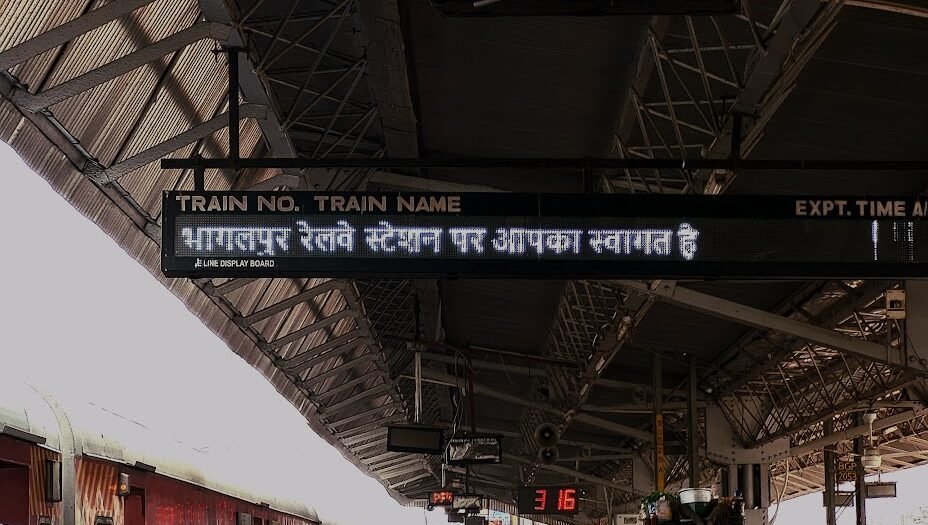
Most people, when they think of Bihar, think of Patna. Of Nalanda. Of the Maurya Empire. They picture one identity, one culture, one accent. Bhagalpur destroys that picture.
Tucked along the southern bank of the Ganga, 220 km east of Patna, Bhagalpur is one of those rare cities that carries the weight of civilisations — plural. Ancient kingdoms, Buddhist universities, blind river dolphins, centuries-old silk looms, a language of 15 million people that most of India has never heard of — all in one place. And it gives off a completely different vibe from the rest of Bihar.
This is the story of Bhagalpur: where it came from, what makes it rare, and why it is finally getting the attention it always deserved.
If you want to understand Bhagalpur’s silk specifically — the craft, the GI tag, the weavers — read our deep-dive: Bhagalpur Silk: The Complete Story of India’s Silk City.
🏛️ From Champa to Bhagalpur — A City Older Than History Remembers
The name “Bhagalpur” likely derives from Bhagdatpuram — the city of good fortune — from the era of the ancient Anga Kingdom. But the city’s roots go even deeper than its name.
Anga was one of the sixteen Mahajanapadas — the great political kingdoms of ancient India — with its capital at Champa, located at the confluence of the Champa and Ganga rivers, in what is now Champanagar, Bhagalpur. Buddhist texts counted Champa among the six greatest cities of ancient India alongside Shravasti, Rajagriha, Vaishali, Koshambhi, and Varanasi.
Key moments from Bhagalpur’s ancient timeline:
- 1500–1000 BCE: Anga Kingdom flourishes. The Atharvaveda mentions Anga and Magadha as neighbouring powers, separated by the River Champa.
- Mahabharata era: Karna, the great warrior of the Mahabharata, is crowned King of Anga by Duryodhana. Champa becomes his capital. This connection to Karna is still a living part of Bhagalpur’s identity today.
- 6th century BCE: Magadha absorbs Anga. But the cultural identity of the region — its language, its festivals, its way of life — never disappears.
- Maurya to Gupta period: Bhagalpur flourishes as a major trade hub. Archaeological excavations have found ancient coins and boat fragments from the Middle and Far East near Champanagar — proof of a harbour city with global trade connections as early as the 7th century.
- Late 8th century CE: Vikramshila University is founded by King Dharmapala of the Pala dynasty, 44 km east of the city — cementing Bhagalpur’s place alongside Nalanda as a global centre of learning.
- 1193 CE: Bakhtiyar Khilji destroys both Nalanda and Vikramshila. Four hundred years of Buddhist scholarship end in a single invasion. The ruins remain.
What this means is that Bhagalpur was not a footnote city. It was a capital. A port. A centre of global learning. The weight of all of that history is still palpable in the city today.
📚 Vikramshila — The University Bihar Forgot to Be Proud Of
Everyone knows Nalanda. Barely anyone outside eastern Bihar knows Vikramshila.
Founded in the late 8th century CE by the Pala king Dharmapala, Vikramshila was not a minor university. It was the primary centre of Tantric Buddhism in the world — drawing scholars from Tibet, China, Southeast Asia, and across the Indian subcontinent. It had over 100 teachers and 1,000 students at its peak.
And now — more than 800 years after its destruction — a new Vikramshila Central University is being established next to the ruins, as announced during the PM’s address at development works in Bhagalpur. The ancient is being reclaimed.
“During the era of Vikramshila University, Bhagalpur was a global centre of learning. Following in Nalanda’s footsteps, a Central University is now being established in Vikramshila.”
— Prime Minister Narendra Modi, address at Bhagalpur development launch

The ruins of Vikramshila today sit at Antichak village in Kahalgaon. The excavated site reveals the scale of what was here: a massive cruciform stupa, monastic cells arranged in a quadrangle, and inscriptions in multiple scripts. For anyone interested in Buddhist heritage, this is Nalanda-level significance with a fraction of the tourist traffic.
🐬 The Blind Dolphin of the Ganga — Bhagalpur’s Rarest Resident
Here is something that stops people in their tracks: Bhagalpur is home to the only dolphin sanctuary in India.
The Vikramshila Gangetic Dolphin Sanctuary covers a 60 km stretch of the Ganga from Sultanganj to Kahalgaon. It was notified in 1991 under the Wildlife Protection Act. The Gangetic river dolphin — classified as Endangered on the IUCN Red List — is one of only four freshwater dolphin species in the world. The other three are in the Yangtze (China), the Indus (Pakistan), and the Amazon (South America).
What makes this dolphin extraordinary:
- Functionally blind — they navigate entirely through echolocation, emitting ultrasonic sound waves to hunt and move through the river.
- Ancient animal — the Gangetic dolphin has existed in the subcontinent’s rivers for millions of years.
- National symbol — declared India’s National Aquatic Animal in 2009.
- Concentrated here — of the few hundred remaining in the world, more than 250 dolphins with calves have been sighted near Bhagalpur’s Jahnvi Ghat region — roughly half the global population.
Locally they are called Soons. Watching one surface near the Barari Ghat at dawn is the kind of moment you do not forget.
The sanctuary is also an Important Bird Area, with 198 bird species recorded including globally threatened Greater and Lesser Adjutant storks. Between 2007 and recent surveys, Bhagalpur’s population of the endangered Greater Adjutant (locally associated with the mythical Garuda) grew from 78 birds to over 500 — making Bhagalpur one of only three nesting sites in the world alongside Cambodia and Assam.
Best time to spot dolphins: October to April. Boat rides from Barari Ghat or Manik Sarkar Ghat.
🗣️ Angika — The Language 15 Million People Speak and India Doesn’t Know Exists
When people ask what makes Bhagalpur different from the rest of Bihar, the most honest answer is: it has its own civilisational identity.
Angika is spoken by 15 to 20 million people across eastern Bihar — in Bhagalpur, Munger, Banka, and surrounding districts. It is a distinct language (not a Hindi dialect) in the eastern Indo-Aryan group, with its own phonology, vocabulary, and literary tradition. And yet it has been repeatedly miscounted as Hindi in census after census.
This erasure is what gives Bhagalpur its quiet, persistent sense of distinction. The city has never fully identified as generically “Bihari.” It was Anga before it was Bihar. It has its own:
- Language — Angika, with its own literature, poetry, and folk songs
- Festival calendar — Kali Puja (not Diwali) is the biggest festival here. The Shobhayatra procession in 2024 completed its 71st year — a 36-hour event that is entirely unique to this region
- Folk tradition — Bishari Puja (Manasa Puja), celebrating Goddess Manasa, originated in Champapuri (ancient Bhagalpur) and spread across Bengal. The legend of Behula and Lakhinder is sung here in Angika.
- Art form — Manjusha Art, a scroll painting tradition exclusive to the Anga region, depicting the Behula-Lakhinder story in bright folk colours
- Food identity — the fish preparations, the Thekua sweet, the Paniyota Bhaat (fermented rice, like Bengal’s Panta Bhaat) — all distinct from rest of Bihar
The Bisua (Baisakkha) new year is celebrated here on April 14–15 with a ritual not found elsewhere in Bihar. The Ganga, the Anga identity, the Angika tongue — these create a city that faces east, toward Bengal and the Bay, rather than west toward Patna.
🧵 The Silk That Made the World Take Notice
You cannot write about Bhagalpur without its silk — the craft that gave it its most recognisable identity.
Bhagalpuri Tussar silk is not decorative heritage. It is a living, working industry with over 50,000 weaver families directly or indirectly linked to it, many concentrated in the Nathnagar district of the city. The silk holds a GI (Geographical Indication) tag, meaning no silk produced outside Bhagalpur can legally carry the name. It is exported to Japan, Europe, and West Asia.
What makes Bhagalpuri Tussar different is not just the thread — it is the forest. The silk is produced from wild Antheraea mylitta silkworm cocoons found on Arjuna, Sal, and Asan trees in the forests of Jharkhand and Bihar. No two weaves are identical. The natural golden slubs and textural irregularities that look like “imperfections” to the untrained eye are precisely what make each piece a one-of-a-kind object.
👉 For the full deep-dive on Bhagalpuri silk history, craft, and buying guide: Bhagalpur Silk: The Complete Story of India’s Silk City
📰 Recent News: Bhagalpur in 2025–2026
After decades of being overlooked in central development plans, Bhagalpur is now on multiple government radars simultaneously.
What is happening right now:
- PM MITRA push for Bhagalpur: Union Minister Chirag Paswan wrote to PM Modi in May 2025 urging Bhagalpur’s inclusion in the PM MITRA Yojana — the national scheme to set up mega textile parks. Bhagalpur currently has no representation in the scheme despite having over 50,000 weaver families. The letter specifically cited the “Queen of Fabrics” status of Bhagalpuri silk and its global demand in Japan, Europe, and West Asia.
- Vikramshila Central University under construction: The new central university — announced alongside PM Modi’s address on Bhagalpur development — is being built next to the ruins of the original Vikramshila Mahavihara. A new rail bridge from Vikramshila to Kataria has also been sanctioned.
- Smart City Mission: Bhagalpur was selected among India’s 100 Smart Cities under the Smart City Mission. The ₹1,309 crore project covers smart roads, CCTV infrastructure, digital governance, and most importantly — silk industry modernisation through digital marketing and export incentives.
- Silk infrastructure development: The central government has announced focused development of fabric dyeing units, yarn processing facilities, and fabric printing units specifically for Bhagalpur’s weaving cluster — addressing one of the sector’s longest-standing infrastructure gaps.
- Namami Gange and dolphin conservation: PM Modi specifically acknowledged Bhagalpur’s dolphin conservation under the Namami Gange initiative during his address, signalling continued central attention to the sanctuary.
🌊 The Ganga Factor — Why Bhagalpur Feels Different
There is something specifically about a Ganga city that is different from an inland city. Bhagalpur has lived on the river for three thousand years — not as a religious transit point, but as a port, a trading hub, a boundary city between cultures.
The Ganga here carries boats toward Bengal. The air carries the smell of the river and the sound of loom shuttles. The city faces east. The food borrows from both Bihar and Bengal. The festivals borrow from both Hinduism and Islam — over 29% of Bhagalpur’s population is Muslim, many of them the very weaver families that kept the silk tradition alive through centuries of disruption.
When you stand at Barari Ghat in the early morning — watching the mist come off the Ganga, hearing the distant sound of looms in Nathnagar, knowing that blind dolphins are navigating the currents below — you understand why Bhagalpur is not just a city. It is a feeling.
No other part of Bihar gives you that particular combination: ancient kingdom history + Buddhist learning + Ganga ecology + silk craft + a language and culture that never fully surrendered its distinctness.
That is the Bhagalpur vibe. And it is irreplaceable.
A City Still Being Discovered
Bhagalpur has spent decades being overlooked on the national stage. Nalanda got the headlines. Patna got the investment. Bhagalpur got passed over in scheme after scheme.
But the city never stopped being what it is. The looms kept running. The dolphins kept surfacing. The Angika language kept being spoken. The Kali Puja procession completed its 71st year. The silk kept going to Japan and Europe.
Now, with Vikramshila University rising from its own ruins, with PM MITRA advocacy gathering momentum, with dolphin populations growing under conservation, Bhagalpur is entering a new chapter.
If you have never been — go. If you cannot go — start with the silk. It is the most portable piece of Bhagalpur’s soul you can carry home.
→ Explore authentic Bhagalpuri silk and the craft behind it: Bhagalpur Silk: The Complete Story of India’s Silk City
Sources used in this article:
- Bhagalpur Complete Guide 2026 — rahul.biz
- Bhagalpur — Wikipedia
- Anga Kingdom — Wikipedia
- History of Bhagalpur — Official District Government Site
- Vikramshila Gangetic Dolphin Sanctuary — Wikipedia
- PM’s address on Bhagalpur development — pmindia.gov.in
- Chirag Paswan’s PM MITRA letter — Textile Insights
- Angika Language & Anga Region Guide 2026 — rahul.biz
- VGDS Conservation Report — Eminent IAS
- Ancient History of Bhagalpur — Echoes of Time