
You just bought a Bhagalpuri Tussar silk saree. It cost ₹3,000 or ₹8,000 or maybe more — and it represents something far beyond money. It carries the work of a weaver in Nathnagar, the heritage of the Silk City, the texture of a wild silkworm that fed on Arjun and Asan trees in the forests of Jharkhand.
And then comes the first worry: How do I wash it without ruining it?
Most saree owners either over-rely on dry cleaners (expensive, and sometimes damaging) or panic and never wash the saree at all. Neither is right. Bhagalpuri Tussar silk — unlike delicate Banarasi or Kanchipuram — is actually one of the more forgiving silks to care for at home, provided you follow the right method.
This guide gives you the complete process: what to use, what to never do, how to wash, dry, iron, and store your Tussar silk saree so it stays beautiful for decades.

Why Tussar Silk Needs Special Care
Tussar silk (also called Kosa silk or wild silk) is fundamentally different from mulberry silk. It comes from the Antheraea mylitta silkworm — a wild creature, not a farmed one. This gives Tussar its characteristic natural golden hue, earthy texture, and slightly coarser weave compared to the smooth sheen of mulberry varieties like Banarasi or Mysore silk.
These natural properties mean a few important things for care:
- Tussar is protein-based — like your hair. Harsh chemicals, hot water, and friction break down the protein fibers and destroy the natural texture permanently.
- The natural slubs and golden colour can bleed slightly in the first wash or two — this is normal and expected for naturally dyed or raw Tussar.
- Tussar is more durable than mulberry silk — it can handle gentle hand washing without falling apart, unlike more fragile silk varieties.
- It should never go in a washing machine — the agitation destroys the natural slubs and warp structure of handloom-woven Tussar within minutes.
What You Need Before You Start
Gather these before touching water:

- A wide, clean basin or bucket — large enough for the saree to move freely without being scrunched
- Cold or lukewarm water — never hot. Heat permanently damages silk protein fibers.
- Mild liquid detergent or baby shampoo — use just 1–2 teaspoons. Ideal options: Ezee, Genteel, or any silk-specific detergent. Baby shampoo works excellently.
- White muslin cloth or soft cotton towels — for absorbing water after washing. Never use coloured towels that may bleed.
- Cotton gloves (optional but recommended) — the natural oils and salts on your hands can stain raw Tussar, especially in lighter shades.
- A clean, shaded drying area — indoors, away from direct sunlight
What to absolutely avoid: Detergent bars (too harsh), bleach, fabric softeners, OxiClean or any oxygen-based cleaners, hot water, and your washing machine.
Step-by-Step: How to Wash Your Bhagalpuri Tussar Silk Saree at Home

Step 1 — Test for colourfastness first
Before washing the whole saree, take a small inconspicuous section — a corner of the pallu — and dab it with a wet white cloth. If colour transfers heavily onto the white cloth, the saree needs dry cleaning for this wash. Light colour transfer is normal for first-time washing of naturally dyed Tussar.
Step 2 — Fill the basin with cold water
Fill your clean basin with cool or room-temperature water. Add 1–2 teaspoons of mild liquid detergent. Swirl gently with your hand to dissolve — do not create excess foam.
Step 3 — Submerge and gently swirl
Fold the saree loosely and lower it into the basin. Gently press it down so the entire fabric is submerged. Using slow, circular hand movements, swirl the saree gently in the water. Do this for 3–5 minutes. Do not scrub any section with your nails or rub fabric against fabric.
For any stained area (food, sweat, kumkum), use a soft sponge or muslin cloth and dab very gently — never rub.
Step 4 — Rinse thoroughly
Drain the soapy water. Refill the basin with fresh cool water and swirl the saree again to rinse. Repeat 2–3 times until the water runs clear and no detergent remains. Detergent residue left in silk stiffens the fabric and dulls the natural sheen over time.
Optional vinegar rinse: In the final rinse water, add 1 tablespoon of white vinegar. This neutralises any alkaline detergent residue, restores the slight natural acidity of silk protein, and helps retain the fabric’s sheen. It sounds unusual but it is a well-known silk care technique.
Step 5 — Remove water without wringing
Never wring or twist a wet Tussar silk saree. The wet silk fibres are at their most fragile and twisting will permanently distort the weave and create creases that will never fully iron out.
Instead: lift the saree gently from the basin and lay it flat on a large, clean white cotton towel. Roll the towel with the saree inside it — like a Swiss roll — and gently press. The towel will absorb most of the water without any mechanical stress on the silk.
How to Dry a Bhagalpuri Tussar Silk Saree Correctly

After the towel-roll step, your saree will be damp — not dripping. Now:
- Hang it on a wooden or plastic hanger indoors, or lay it flat over a clean rack or rope in a shaded, well-ventilated room. Both methods work.
- Keep it away from direct sunlight. UV light bleaches the natural golden pigmentation of Tussar silk and degrades the protein fibres. Even one or two drying sessions in direct sun will noticeably dull the saree.
- Do not use a dryer — ever. Heat destroys Tussar irreversibly.
- Do not use a fan on high speed directly blowing on the wet saree — air drying is fine, but forced mechanical airflow can disturb the fibre alignment of delicate handloom weaves.
- Allow 4–6 hours for full air drying depending on humidity. The saree will feel slightly stiff when dry — this is completely normal for Tussar and will soften once worn or ironed.
How to Iron a Tussar Silk Saree
Tussar silk wrinkles more than mulberry silk because of its coarser natural texture — ironing is usually needed after washing. Done correctly, it is perfectly safe.
- Set your iron to the lowest silk setting — usually the single dot or the “silk” symbol. Never use the cotton or linen setting on Tussar.
- Iron while the saree is still slightly damp, or use a light spray of water before ironing. This makes the creases release more easily without requiring more heat.
- Always place a thin cotton cloth between the iron and the saree — direct iron contact on Tussar, even on a low setting, can cause permanent shine marks (called “iron shine”) that cannot be removed.
- Iron in long, smooth strokes in one direction — do not press the iron down hard or use circular motions.
- Never iron the zari or embroidered borders directly. Turn the saree inside out for those sections and iron from the reverse side.
How to Store Your Bhagalpuri Tussar Silk Saree

Proper storage is where most saree owners go wrong — and where long-term damage silently happens.
The muslin wrap method
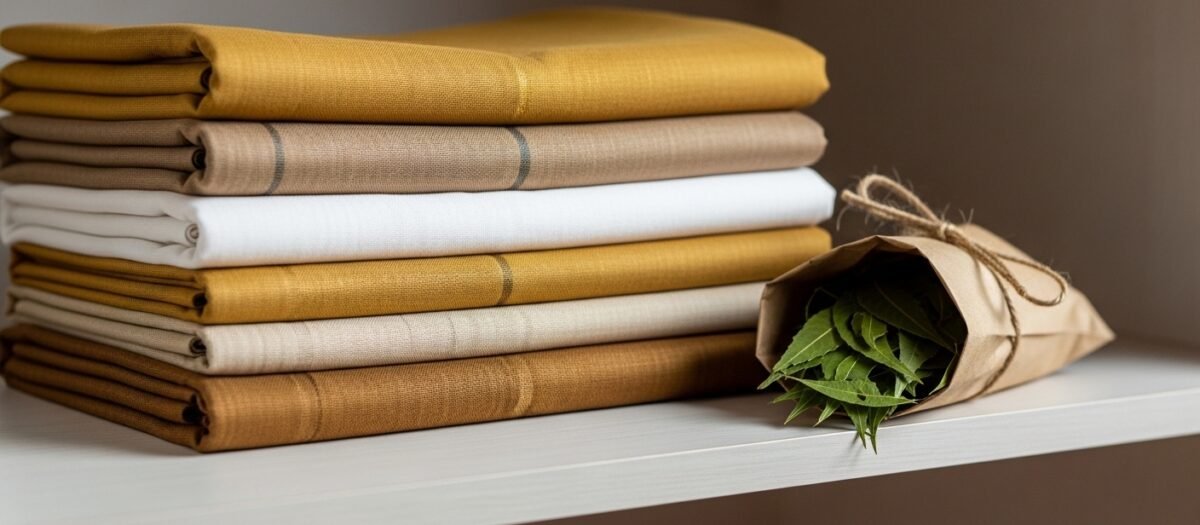
Wrap each Tussar saree individually in a clean white muslin or soft cotton cloth before storing. This does three things: it protects the fabric from dust, prevents colour transfer between sarees stored together, and allows the silk to breathe (unlike plastic covers or ziplock bags, which trap moisture and encourage mildew).
Never store Tussar silk in plastic covers or airtight boxes. Silk is a natural protein fibre — it needs air circulation to remain stable.
The neem leaf method — traditional and proven
Dried neem leaves placed beside stored sarees repel moths, silverfish, and other fabric-eating insects naturally — without the chemicals of naphthalene balls, which actually damage silk protein over time. This practice has been used by weaver families in Bhagalpur for generations. Replace the dried neem every 4–6 months.
Fold correctly — and refold every 3 months
Fold your saree along its natural weave lines where possible. The important thing: every 2–3 months, take the saree out, refold it along different lines, and put it back. Permanent folds along the same crease lines for a year or more will eventually cause the silk fibres to weaken and crack at those points.
Avoid cedar balls and camphor directly on silk
Both camphor and cedar release volatile organic compounds that can interact with silk dyes over long exposure and cause colour shifts. If you use them in your wardrobe for other garments, keep them away from direct contact with your Tussar sarees. A small cloth pouch between them is sufficient.
When to Take It to a Dry Cleaner Instead
Home washing is appropriate for most everyday care situations — post-wear freshening, light soil, sweat from summer events. However, take your Tussar saree to a professional for:
- Heavy or old stains (oil, turmeric, wine, ink)
- Hand-painted Madhubani or Kalamkari work — the natural pigments may not be water-stable
- Heavy zari borders — metal zari can oxidise when repeatedly wet-washed at home
- Sarees with heavy embroidery where the thread count or base is unfamiliar
- Any saree where the colour-transfer test showed very heavy bleeding
When choosing a dry cleaner, always specify “silk — no heat press” and ask whether they use petroleum-based or water-based solvents. Petroleum-based (perchloroethylene) cleaning is the traditional standard and generally safe for Tussar.
Quick Reference: Do’s and Don’ts
| Do | Never Do |
|---|---|
| Use cold or lukewarm water | Use hot water |
| Use mild liquid detergent or baby shampoo | Use detergent bars, bleach, or fabric softener |
| Swirl gently in the basin | Scrub, rub fabric against fabric, or wring |
| Roll in a white towel to remove water | Spin in a washing machine |
| Dry flat in shade indoors | Dry in direct sunlight or machine dryer |
| Iron on silk setting with a cotton cloth buffer | Apply iron directly to Tussar fabric |
| Wrap in white muslin for storage | Store in plastic covers or airtight bags |
| Use dried neem leaves for insect repellent | Use naphthalene or camphor directly on silk |
| Refold every 2–3 months | Store with permanent fold lines for over a year |
How Often Should You Wash a Tussar Silk Saree?
Less often than you think. Unlike cotton, silk does not need to be washed after every single wear. Tussar silk’s natural texture is relatively soil-resistant and breathable — it doesn’t trap body odour the way synthetic fabrics do.
A reasonable care routine for a saree worn occasionally (festivals, family events, weddings): wash once or twice a season, or whenever visibly soiled. Between washes, air it out in a shaded, breezy spot for 1–2 hours after wearing and before folding back into storage. This alone extends the time between washes significantly.
For daily or near-daily wear Tussar (office, cultural events), washing once a month is appropriate with the method described above.
A Note on Tussar’s Natural Character
One last thing worth saying: Bhagalpuri Tussar silk is not a fabric that needs to be perfect. The slight unevenness in the weave, the natural slubs in the thread, the earthy golden colour that shifts subtly with each wash — these are not imperfections. They are the evidence of a living craft, a wild silkworm, and a weaver’s hands.
A Tussar saree that has been worn and washed and carefully stored for twenty years carries something a brand-new saree cannot: a quiet, earned beauty. Care for it well — and it will reward that care for a lifetime.
Also read: Real or Fake? How to Identify Authentic Bhagalpuri Tussar Silk Before You Buy · Tussar Silk vs Mulberry Silk: What Makes Bhagalpur’s Wild Silk Truly Different · Bhagalpuri Ghicha Silk Saree with Madhubani Print — Review 2026