Heritage · Angika Silk Journal
Tussar Silk vs Mulberry Silk: What Makes Bhagalpur’s Wild Silk Truly Different
Craft · Comparison · Bihar Heritage · April 2026 · 15 min read
Walk into any silk market in India and you will hear both names — Tussar and Mulberry — spoken in the same breath, as if they were simply two varieties of the same thing. They are not.
Tussar silk and Mulberry silk are as different as wild honey is from refined sugar. Both are real. Both are valuable. But they come from entirely different worlds, produced by different creatures, shaped by different environments, and carrying — if you look closely — entirely different histories.
At Angika Silk, we are, by nature and by geography, Tussar silk people. Bhagalpur — our city, our home — is India’s Tussar capital, the place where this wild, golden fiber has been woven for over two centuries. But understanding what Tussar is requires understanding what it is not. And what it is not, quite precisely, is Mulberry silk.
This is that story.
Where They Come From: Two Completely Different Origins
Every silk begins with a silkworm. But not all silkworms are the same, and the difference in origin explains nearly everything else that follows.
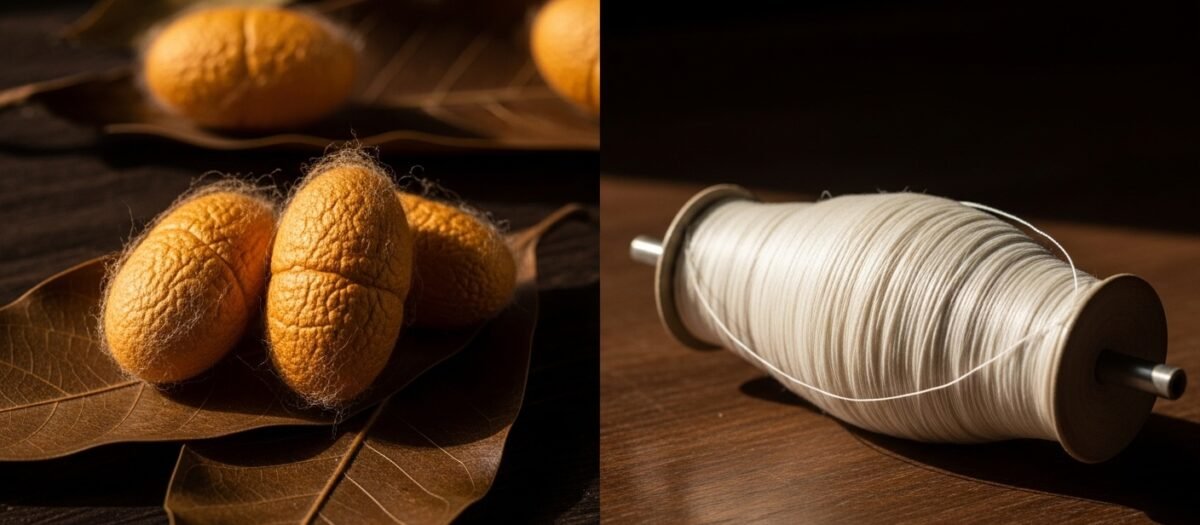
Mulberry silk is produced by Bombyx mori — a fully domesticated silkworm that has been bred for silk production for over five thousand years, primarily in China. These silkworms are raised in controlled indoor environments, fed exclusively on the leaves of the white mulberry tree (Morus alba), and kept at precise temperatures. They produce long, uniform, very fine silk threads — the result of centuries of selective breeding designed to maximize consistency and yield.
Tussar silk is produced by Antheraea mylitta — a wild silkworm that lives in open forests, feeds on the leaves of Arjun (Terminalia arjuna) and Asan (Terminalia tomentosa) trees, and is subject to no such control. These silkworms are semi-cultivated — gathered from the forests, maintained on trees in the open air, and harvested at the end of their natural cycle. No breeding selection for uniformity. No indoor facility. No controlled diet.
The Tussar silkworm lives in the wild. And the silk it produces carries that wildness.
The Fiber: What Your Hand Feels
Touch is where the difference becomes undeniable.
Mulberry silk is the silk of luxury in the conventional sense. Its fibers are long, extremely fine, and perfectly uniform — a result of the controlled conditions in which they are produced. The fabric drapes fluidly, catches light with a bright, almost metallic lustre, and feels extraordinarily smooth against the skin. It is the standard by which most Western luxury silk is judged, accounting for roughly 70% of global silk production.
Tussar silk feels different in a way that is not inferior — it is distinctive. The fibers are shorter, thicker, and naturally irregular, because the silkworm spinning them was not living under controlled conditions. The resulting fabric has a characteristic slub — a slight natural texture, a gentle unevenness that gives Tussar its tactile personality. It does not have the liquid smoothness of Mulberry. What it has is warmth, body, and a subtle golden earthiness that no manufacturing process can replicate.
FeatureTussar SilkMulberry SilkSilkwormAntheraea mylitta (wild)Bombyx mori (domesticated)FeedArjun, Asan trees (wild forest)Mulberry leaves (controlled)Fiber lengthShorter, irregularLong, uniformTextureTextured, slubby, tactileSmooth, fluid, fineNatural colourGolden-amber to warm beigePure whiteSheenMatte to soft glowBright, lustrousBreathabilityVery highHighDyeabilityLimited (earthy tones best)Full spectrumTypical useSarees, kurtas, scarves, décorBridal, luxury wear, beddingPrice rangeModerate to premiumPremium to very premiumGI Tag (India)Bhagalpur Tussar (2013)Multiple regional varieties
The Colour: Why Tussar Cannot Be White
This is the detail that surprises most people.
Mulberry silk begins its life as pure white — because the silkworm’s controlled diet produces a colorless sericin protein coating. This white base means it can be dyed any color with precision and consistency. The vivid reds and electric blues of high-end Kanjivaram sarees, the delicate pastels of luxury bridal collections — all of these are possible because Mulberry silk starts from white.
Tussar silk starts from gold.
The natural amber-to-brown color of Tussar thread comes from the tannins in the Arjun and Asan leaves the silkworm feeds on. This pigmentation is locked into the fiber itself — it cannot simply be bleached away without damaging the fabric’s integrity. This means Tussar silk works beautifully in earthy, warm tones: rusts and ochres, deep greens, maroons, indigo, chocolate brown. The golden undertone of the base fiber adds warmth and depth to any color placed over it.
What Tussar cannot be is a bright white, a pastel pink, or a neon yellow. It does not work in cool, light tones. This is not a flaw — it is an identity. The warmth of Tussar’s color palette is inseparable from its character.
In Bhagalpur’s weaving tradition, this color constraint became a design philosophy. The master weavers here do not fight the gold — they work with it. The natural base color becomes part of the weave’s story, a reminder that this fabric came from something living, something wild, something that grew on a tree in a forest somewhere on the banks of the Ganga.
Sustainability: The Wild Silk Difference
This is where Tussar silk deserves particular credit.
The production of Bombyx mori Mulberry silk requires the cocoon to be boiled while the pupa is still inside — a process necessary to unravel the long continuous filament. This means the silkworm does not survive the silk extraction process in conventional Mulberry silk production.
Tussar silk production, particularly in its traditional Bhagalpur form, follows a different path. The Antheraea mylitta silkworm lives in the open forest on its natural food trees. While commercial Tussar also involves cocoon processing, the semi-wild nature of the silkworm’s life cycle — and the fact that Tussar silk can also be produced from pierced cocoons (after the moth has emerged) — makes it more compatible with low-intervention, ecologically embedded production.
The 35,000 weaver families of Bhagalpur have sustained this tradition across generations not because it was economically optimal in a modern sense, but because it was embedded in the local ecology and culture. The Arjun and Asan trees that feed the silkworms grow naturally in Bihar and Jharkhand. The forests are the source. The craft follows the forest.
In an era where consumers are increasingly conscious of how their textiles are produced, Tussar silk’s wild origin story is not a marketing point — it is a genuine differentiator.
What Bhagalpur Does Differently
Bhagalpur’s relationship with Tussar silk is not simply commercial. It is civilizational.
The city — ancient Champa, mentioned in the Ramayana and Mahabharata as the capital of the Kingdom of Anga — has been weaving silk for over two centuries. The 2013 Geographical Indication tag granted to Bhagalpur silk by the Government of India recognized something the city already knew: that this silk, produced in this place, by these hands, from these forests, is a distinct thing in the world. Not interchangeable with Mulberry silk. Not interchangeable with silk from anywhere else.
Bhagalpur’s weavers work primarily on pit looms — traditional structures that have not fundamentally changed in design for generations. The Tussar fabric they produce has a characteristic hand-woven irregularity that power-loom Mulberry silk cannot replicate. The slightly uneven weave, the visible texture, the warmth that you can feel when you drape the fabric — these are the fingerprints of human hands at work.
A Bhagalpur Tussar saree is not a luxury object in the way that a Mulberry silk saree from a heritage brand might be. It is something different: an artifact. A textile that carries in it the forest, the river, the hands, and the history of a very specific place.
Which One Should You Choose?
This is the wrong question, technically. The right question is: what do you need the fabric for?
Choose Mulberry silk when you need fluid drape, vivid color, bright sheen, or the texture of the lightest possible fabric against the skin. For bridal wear, formal evening occasions, or luxury bedding, Mulberry’s refinement is unmatched.
Choose Tussar silk — specifically Bhagalpur Tussar — when you want texture, warmth, and character. When you want a fabric that tells a story. When you want something that is not smooth-perfect but is honest and alive. For daytime sarees, kurtas, stoles, office wear with personality, or handloom pieces that carry heritage, Tussar is the choice.
Many Indian women who understand fabric keep both. A Kanjivaram Mulberry saree for the wedding. A Bhagalpur Tussar for the family puja, the literary festival, the autumn morning when the light is just right and you want to wear something that feels like the earth it came from.
A Note on Authenticity
One caution, always: the term “Tussar silk” is sometimes used loosely in Indian markets to describe blended fabrics or even synthetic imitations of the Tussar texture. Authentic Bhagalpur Tussar carries the GI tag — look for it when buying, particularly online.
The GI tag (Geographical Indication, granted 2013) means the silk was produced in Bhagalpur district, by registered weavers, from genuine Antheraea mylitta Tussar filament. It is your guarantee not just of quality but of provenance — that the fabric you are holding came from a specific forest, a specific city, a specific tradition.
There is no substitute for that. And there should not be.
Angika Silk · Bhagalpur, Bihar, India · Celebrating 200+ years of Tussar silk heritage
namaste@angikasilk.com