The sound of a Bhagalpuri pit loom is unlike any other sound in India. It is rhythmic but not mechanical — a soft tak-tak of the shuttle, the sigh of yarn pulled tight, the creak of pedals worked by feet that have done this for forty years. In Nathnagar, on the southern edge of Bhagalpur city in Bihar, that sound rises from courtyards every morning before sunrise. It has been rising for centuries.
What you eventually buy as a Bhagalpuri silk saree — that golden-coppery, slubbed, slightly raw fabric that drapes like nothing else — is the final form of a 14-step journey that begins in a forest sometimes 200 kilometres away from the loom. Most articles tell you the saree is “handwoven.” That word does almost no justice to what actually happens.
This is the full process. Cocoon to drape. Every step. Why a real Bhagalpuri silk saree takes weeks of work by five to eight different artisans, why it costs what it costs, and how to tell a genuine one from the power-loom imitations now flooding online stores.
Why “made” matters more than you think
A power loom in Surat can produce a silk-look saree in under thirty minutes. A handwoven Bhagalpuri tussar silk saree takes anywhere from 15 to 45 days, depending on the complexity of the border and pallu. The finished cloth may look superficially similar to an untrained eye. The journey behind each is not even comparable.
Every step that follows is a step where a human decision is made — which cocoons to keep, when to stop boiling, what shade of indigo to settle on, where to place the next motif. A power loom makes none of those decisions. It executes a program. That difference is the difference between cloth and craft.
If you want to understand the full history and heritage of Bhagalpuri tussar silk, that story stretches back to the Vedic age and the ancient Kingdom of Anga. This guide is about something more specific — what happens, today, in the next 30 to 45 days, when an artisan decides to make one saree.
Where it begins: the wild silkworm
Most silk in the world comes from Bombyx mori, the domesticated mulberry silkworm raised on farms and fed cultivated mulberry leaves. Bhagalpuri silk is different. It comes from Antheraea paphia (also called Antheraea mylitta) — a wild silkworm species native to India, traditionally known as the Vanya silkworm, meaning “of the forest.”
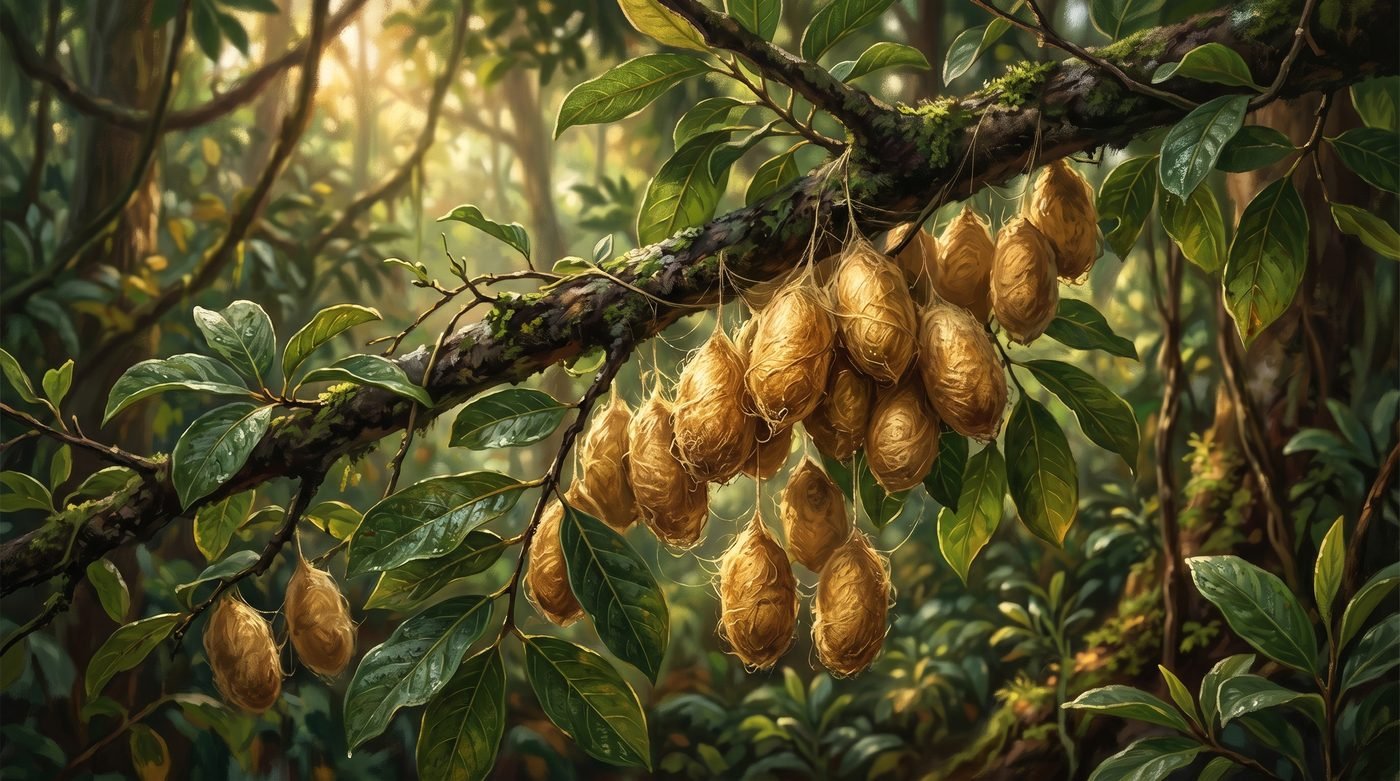
This silkworm is not farmed. It lives in the wild forests of Jharkhand, Chhattisgarh, and parts of Bihar, feeding on the leaves of the Asan, Arjun, and Sal trees. The cocoons it spins are larger, harder, and a natural golden-brown rather than white. This is the source of tussar silk’s distinctive coppery sheen — the colour is not dyed in. It is what the cocoon already is.
Because these cocoons are gathered from the forest rather than produced on a controlled farm, the supply is seasonal, irregular, and dependent on the health of the forest itself. Tribal communities in Jharkhand have collected these cocoons for generations and continue to do so today. From the forest, the cocoons travel by road to Bhagalpur — specifically to the weaver clusters of Nathnagar, also historically called Champanagar, named after the ancient capital city of the Anga kingdom that flourished here when Buddha was alive. Bhagalpur has been India’s Silk City for over a thousand years, and Nathnagar is its weaving heart.
The 14 steps from cocoon to saree
What follows is the full traditional process. Some workshops in Bhagalpur have introduced minor modern improvements — chemical dyes alongside natural ones, slightly modernised pit looms — but the core 14 stages remain remarkably unchanged from how they were done 100 years ago.
Cocoon collection
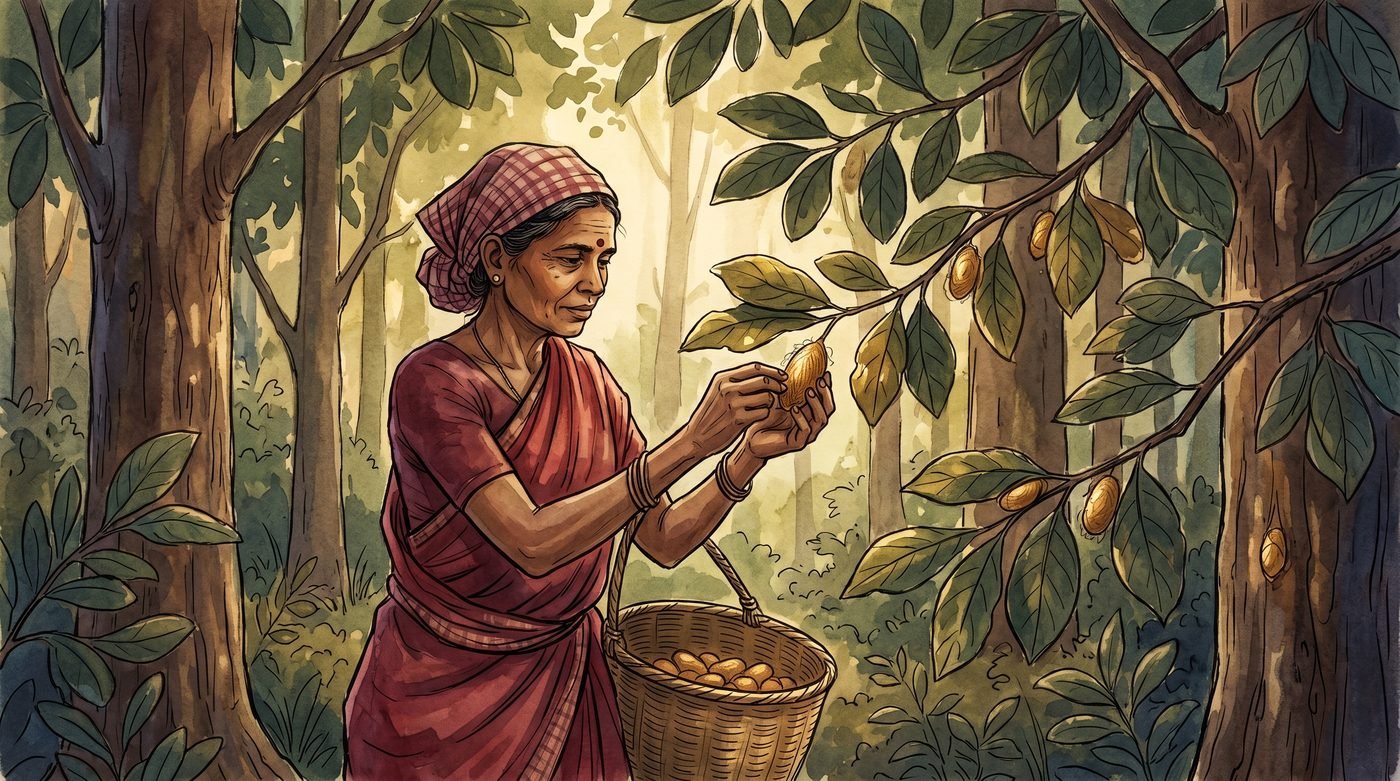
Tribal collectors enter the forest in the late winter and early spring months, when the cocoons are mature. Each cocoon is hand-picked from the host tree branches, usually with the silkworm still inside. The collectors look for cocoons that are firm, evenly shaped, and a deep golden-brown — these produce the finest yarn. A typical day’s collection might fill one to two large cane baskets. From these baskets, weeks of work eventually produce a single saree.
Sorting and grading
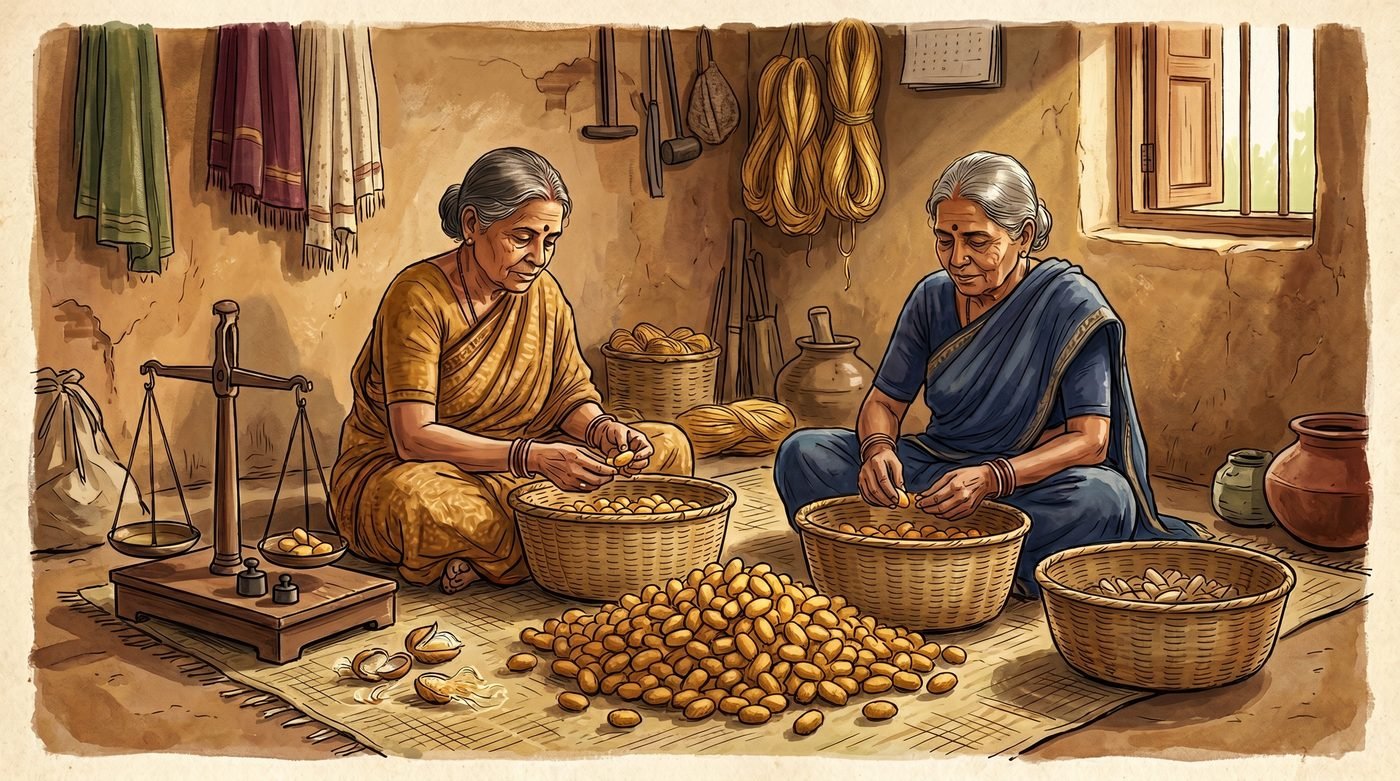
At the cluster centres in Bhagalpur and the Godda district, cocoons are sorted manually. Stained cocoons, broken cocoons, and undersized ones are separated out. The remaining cocoons are graded by size and colour. Higher-grade cocoons go into saree-quality yarn. Lower grades are used for stoles, dupattas, dress material, and the famous Bhagalpuri chadar. This sorting is done by experienced women workers, many of whom have done this since childhood and can grade by feel alone.
Cocoon cooking — softening the gum
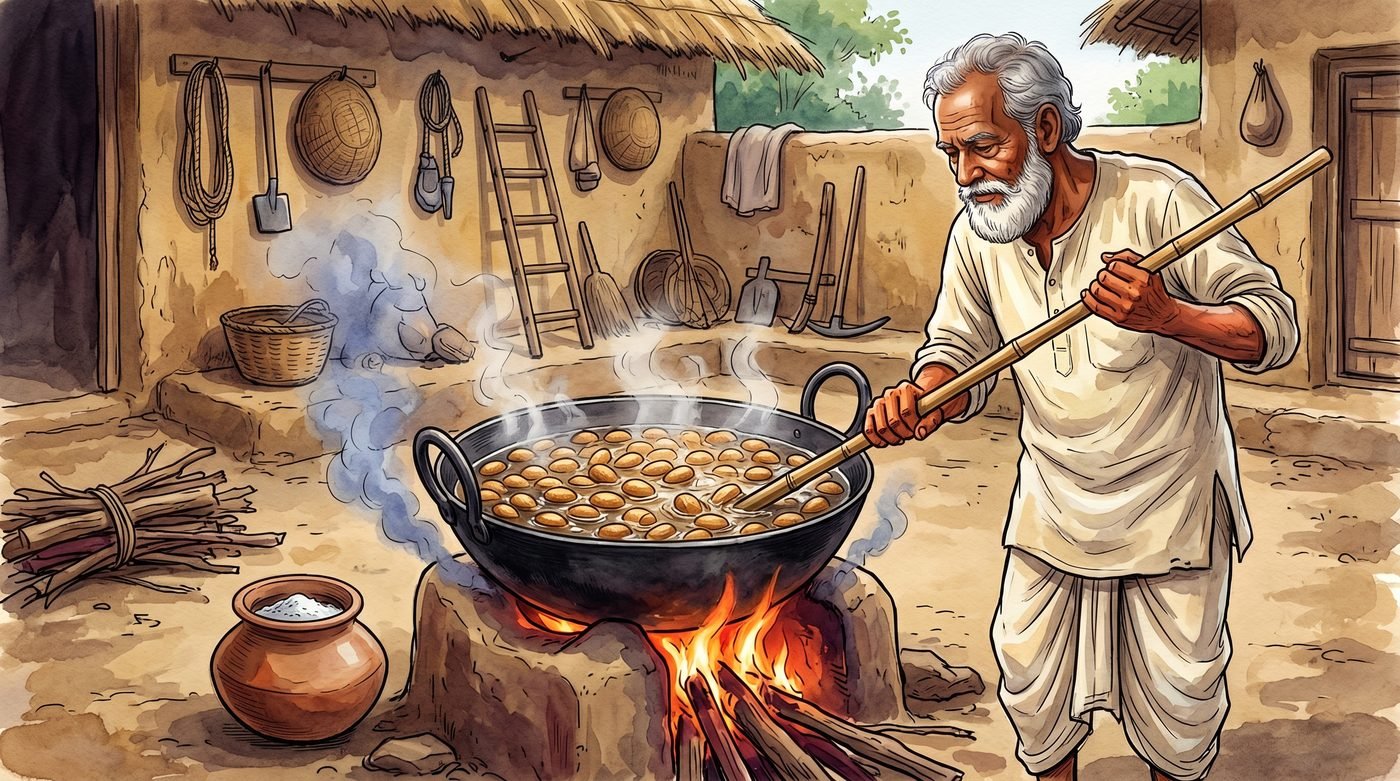
The cocoon’s silk filament is held together by a natural protein called sericin, which acts like a glue. Before the silk can be drawn out, this gum has to be softened. Cocoons are soaked in hot water — sometimes with a mild alkaline solution like soda ash or potash — for several hours. This is a step that requires constant judgement: too little time and the gum stays rigid; too much, and the silk fibres themselves weaken. Master “cookers” in Bhagalpur often work by smell and feel rather than by clock.
A growing minority of artisans practise Ahimsa silk — they wait for the moth to emerge naturally from the cocoon before processing the empty shell. This is gentler but produces shorter, broken filaments and slightly more textured yarn.
Hand-spinning the yarn
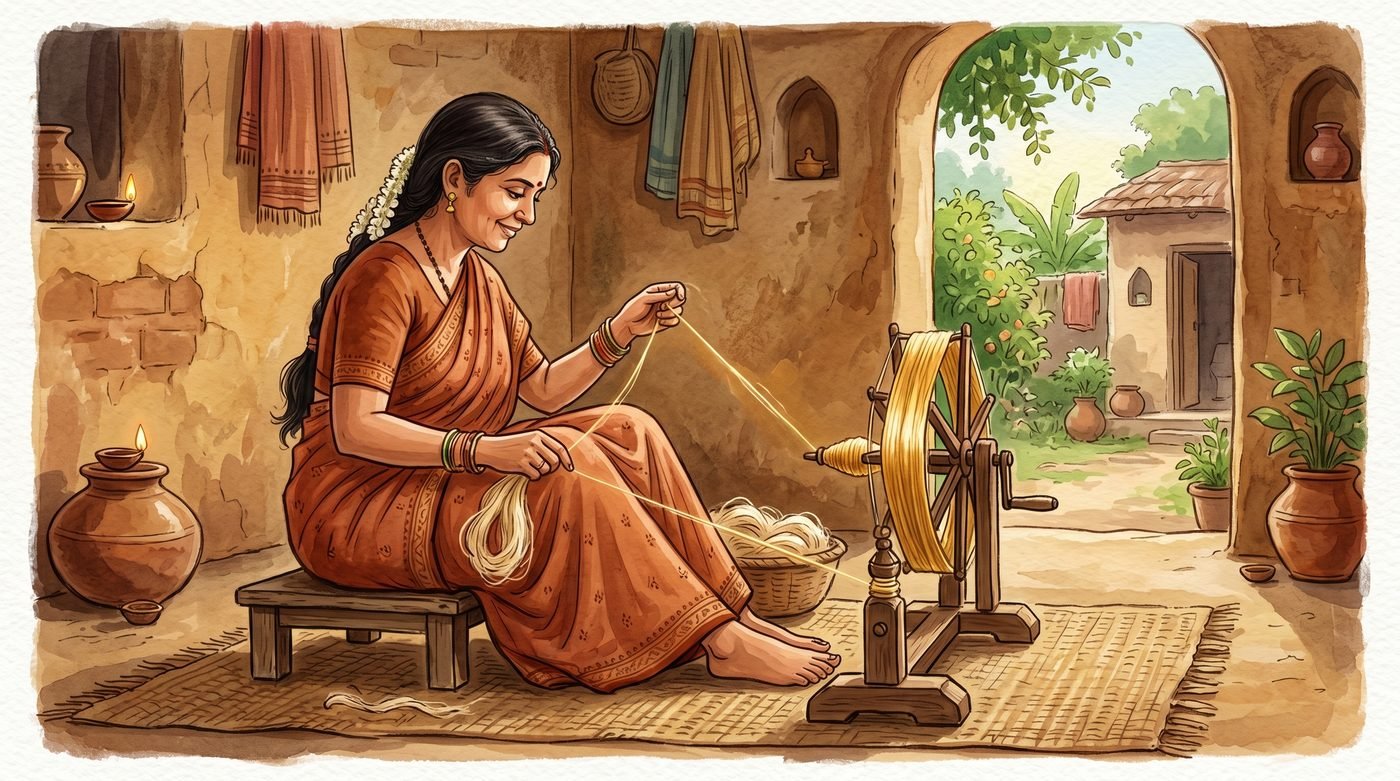
Here Bhagalpuri silk diverges sharply from mulberry silk. With mulberry, the cocoon is unwound in a single continuous filament — a process called reeling. Tussar cocoons cannot be reeled this cleanly because the wild silkworm typically chews through its cocoon when emerging, breaking the long filament. So Bhagalpuri silk is spun, like wool or cotton.
Women, almost always working from home, draw the broken silk fibres together and twist them into yarn on traditional spinning wheels (charkhas) or hand spindles. Spinning a single saree’s worth of yarn can take three to five days of work. The slubs and slight irregularities you can see in a real Bhagalpuri silk saree are the visible record of this hand-spinning. A power-loom imitation will have perfectly uniform thread. A real one will not.
Twisting and strengthening
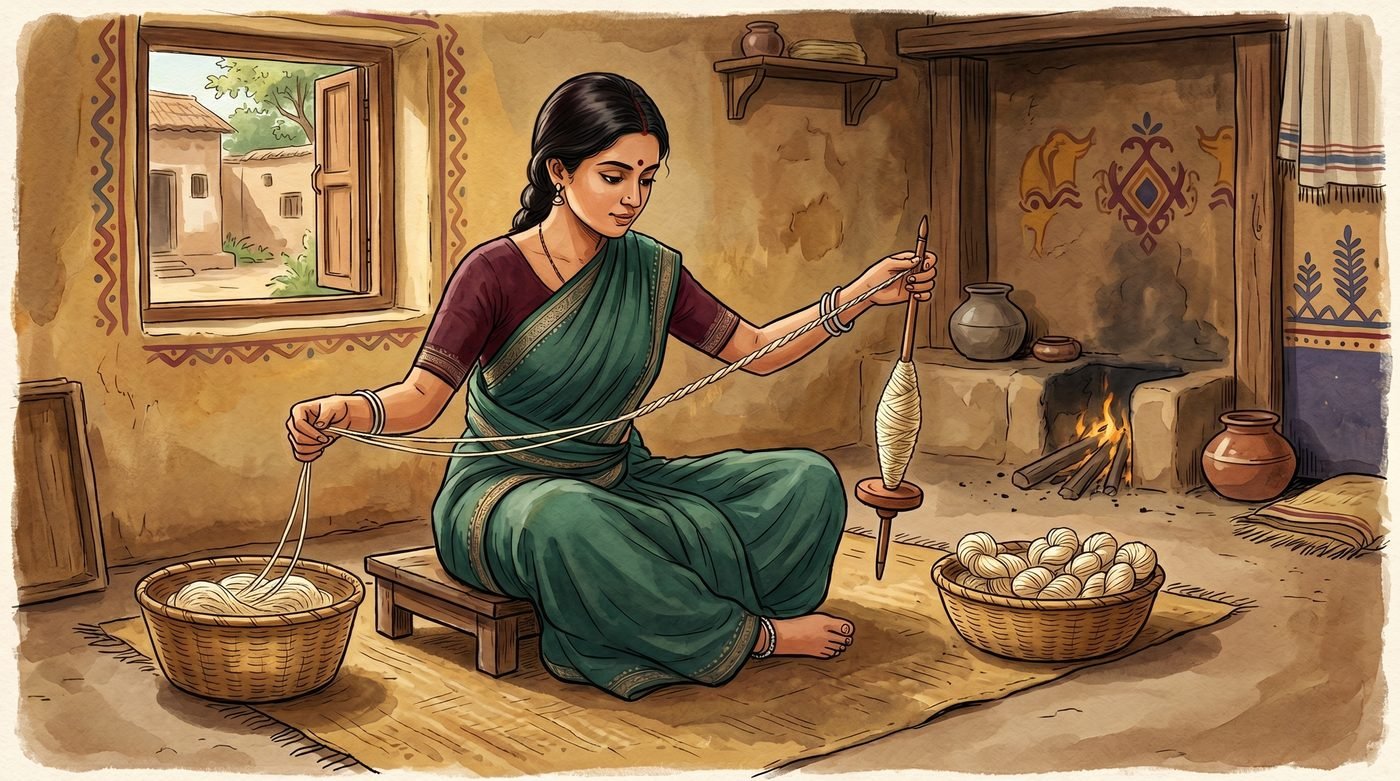
Single-strand spun yarn is too delicate for a saree’s warp threads. Multiple strands are twisted together — this is called plying — to produce thicker, stronger yarn. Different parts of the saree need different counts: finer yarn for the body, thicker yarn for the border, and special heavier yarn for the pallu where the elaborate motifs sit.
Final degumming
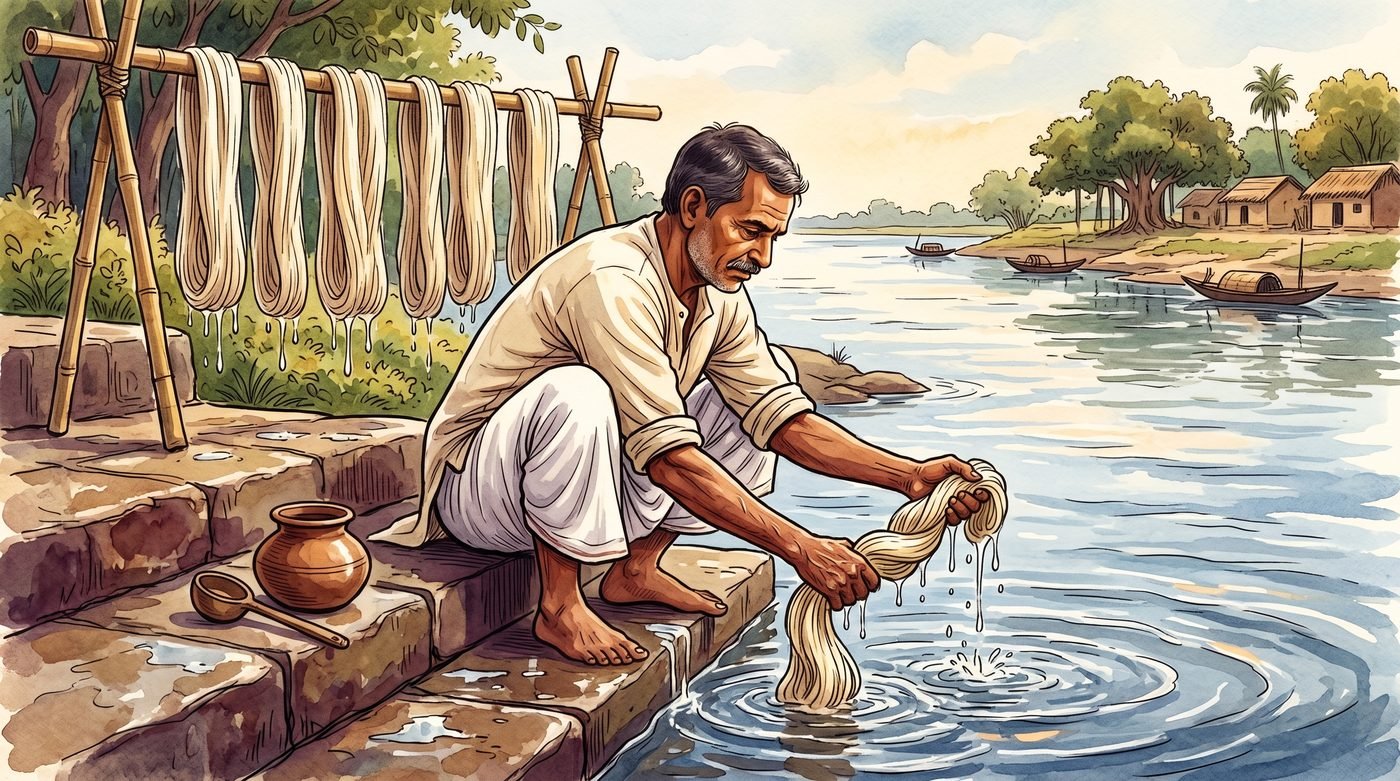
Once spun and twisted, the yarn is boiled again, this time in a milder solution, to remove the last traces of sericin. This second degumming is what gives the finished cloth its characteristic softness and the gentle sheen that catches the light. Skip this step or rush it, and the saree feels stiff and looks dull. After degumming, the yarn is rinsed thoroughly in cold water — traditionally in the river — and wrung out by hand.
Natural dyeing — colour from the earth
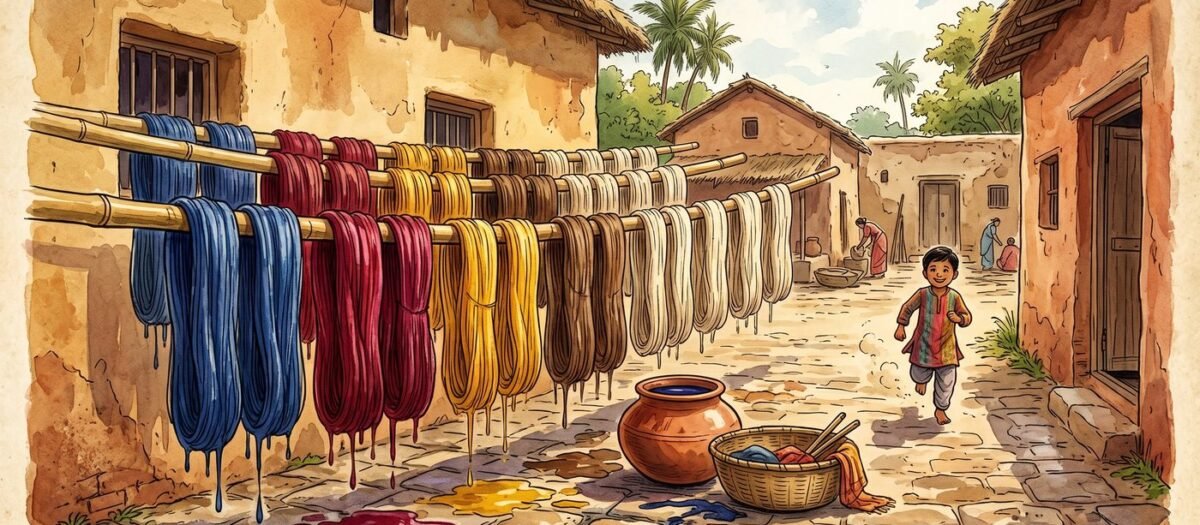
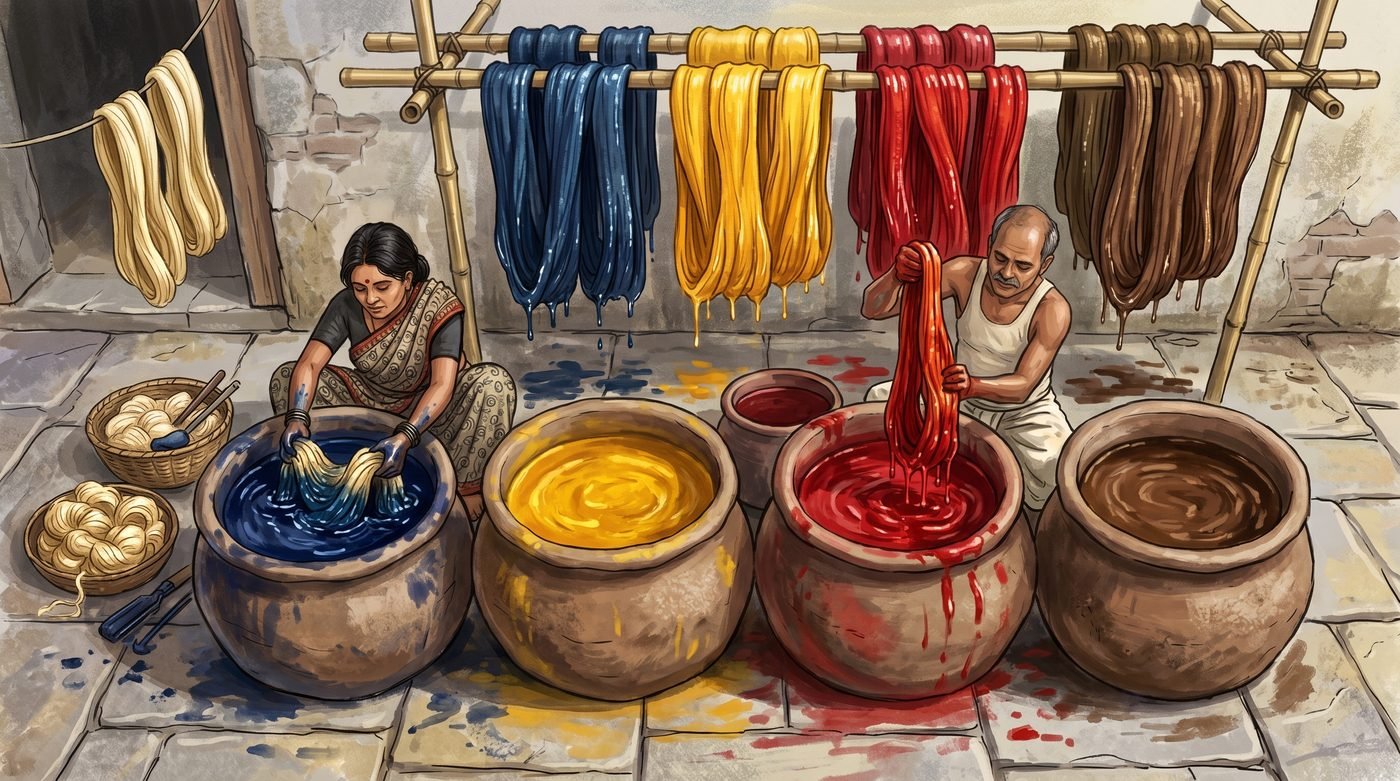
This is one of the most beautiful steps to witness. Skeins of cream-coloured tussar yarn are dipped into large earthen vats of dye and left to soak, then lifted, rinsed, and dipped again — sometimes seven or eight times — until the desired depth of colour is reached.
Traditionally, the dyes come from natural sources:
- Indigo for deep blues
- Turmeric and harsingar flowers for warm yellows
- Lac (a resin from tree-dwelling insects) for rich reds and crimsons
- Walnut shells and iron rust for browns and blacks
- Catechu and madder for ochres and earth tones
Many modern workshops also use chemical dyes for colour ranges that natural dyes can’t easily reach (bright pinks, electric greens). The premium Bhagalpuri sarees, the ones that command higher prices and increasingly find NRI buyers, stay with natural dyes — and you can often see the difference. Natural-dyed yarn has a soft, slightly uneven depth; chemical-dyed yarn is flat and uniform.
Drying the dyed yarn
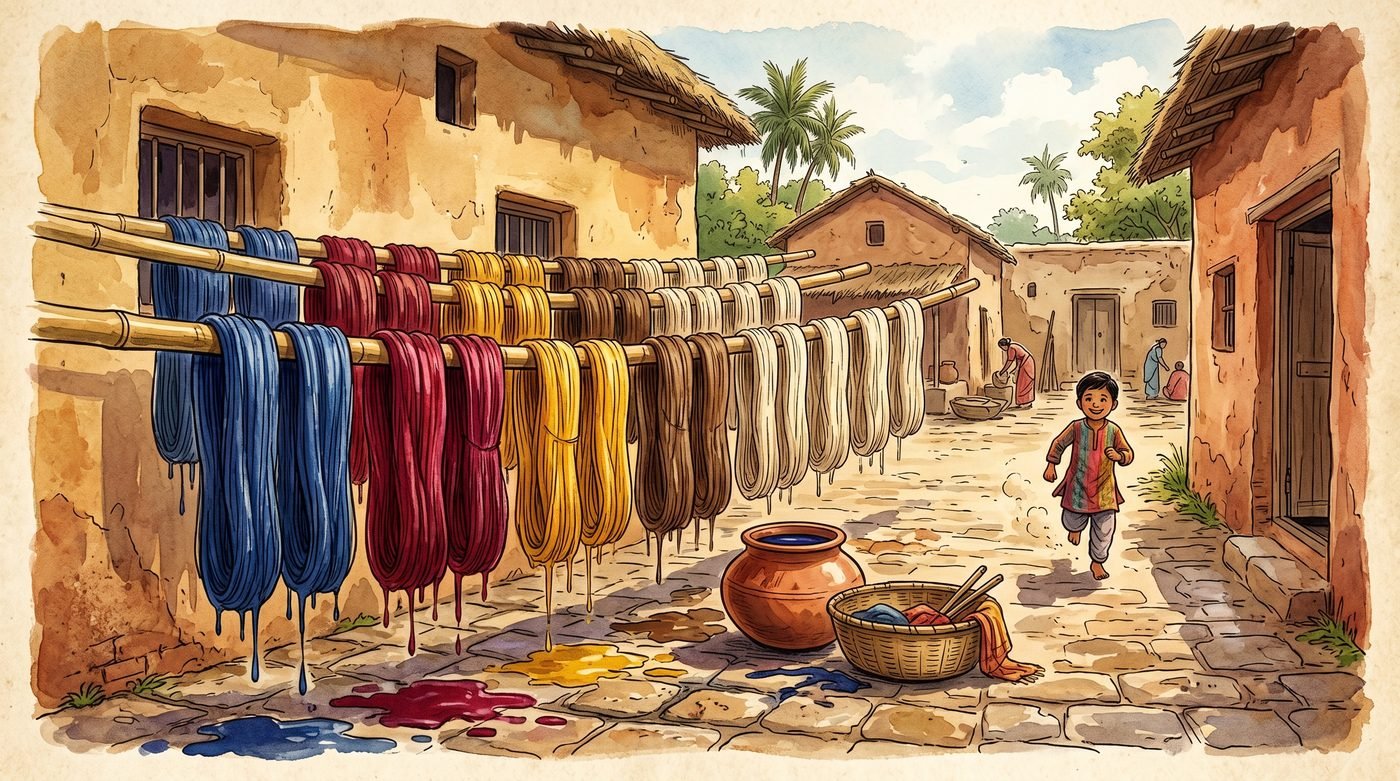
The dyed skeins are wrung out and hung on bamboo poles in open courtyards to dry in the sun. This single image — rows of crimson, indigo, ochre, and gold yarn against a Bhagalpur sky — is what most people picture when they think of a “silk village.” It takes a full day of good sun for the yarn to dry completely. In monsoon, it can take three or four. The colour deepens and sets as the yarn dries.
Warping — the foundation of the saree
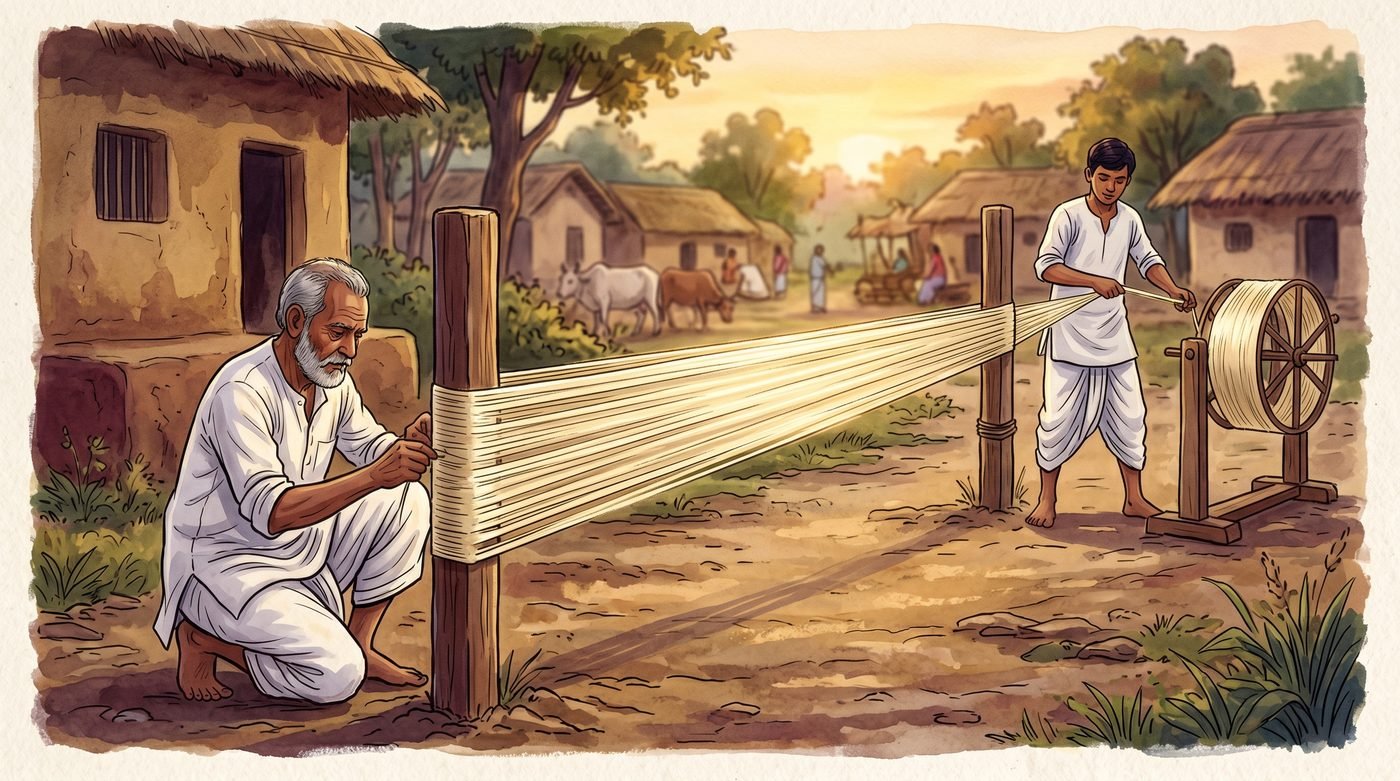
This is the most technically demanding step before the loom even begins. The dried yarn is wound onto large bobbins, and then thousands of long, parallel warp threads are stretched and arranged in the exact width and length the finished saree will have. A typical 6.5-metre saree warp can have between 6,000 and 12,000 individual threads, every single one of which must be perfectly tensioned and in the right position.
Warping is usually done outdoors on a long stretch of open ground. A single mistake here — a tangled thread, an uneven tension — will show up as a defect across the entire saree. Master warpers in Nathnagar are paid a premium because the rest of the process depends entirely on their accuracy.
Setting up the pit loom
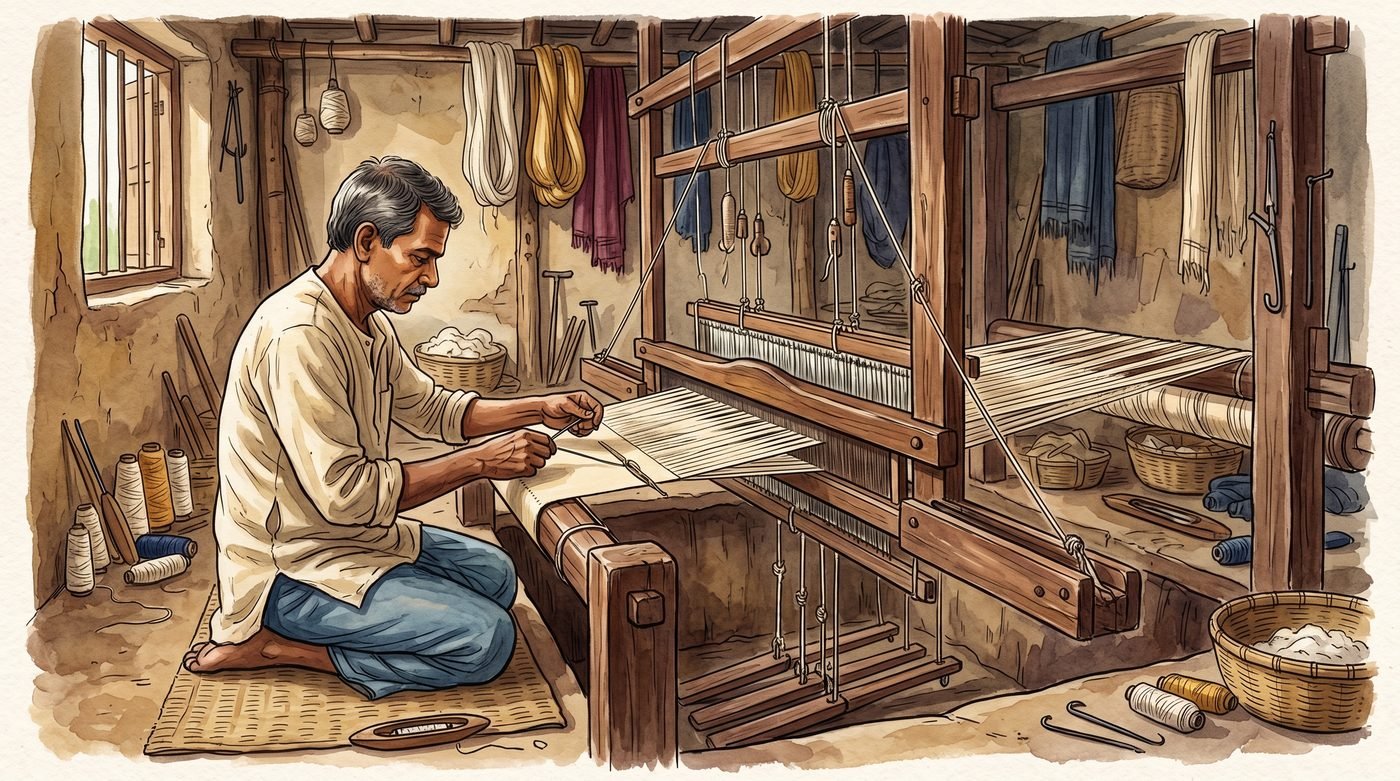
The warp is then transferred onto a traditional pit loom — so called because the weaver sits at the loom with their feet down in a pit dug into the floor, where the treadle pedals are located. This is the same basic loom design used in Bhagalpur for centuries.
Each warp thread is individually threaded through the heddles (which raise and lower threads to create the weave pattern) and through the reed (which keeps the threads spaced evenly). Setting up a single pit loom for a new saree can take an entire day. Once set, that loom is dedicated to that saree until it is finished.
The weaving begins
The actual weaving is what most people imagine when they think of “handwoven.” The weaver presses the foot pedals to lift alternate warp threads, throws the shuttle (carrying the weft yarn) across the loom, then beats the weft into place with the reed. This single motion — lift, throw, beat — is repeated thousands of times per saree.
For a plain Bhagalpuri silk saree with simple borders, an experienced weaver can produce 6 to 12 inches of fabric per day. That works out to roughly 12 to 18 days of weaving for a 6.5-metre saree. The weaver works five to eight hours a day. Anything more and the hands cramp; anything less and the rhythm breaks. There is no rushing.
Borders and pallu — where the saree becomes art
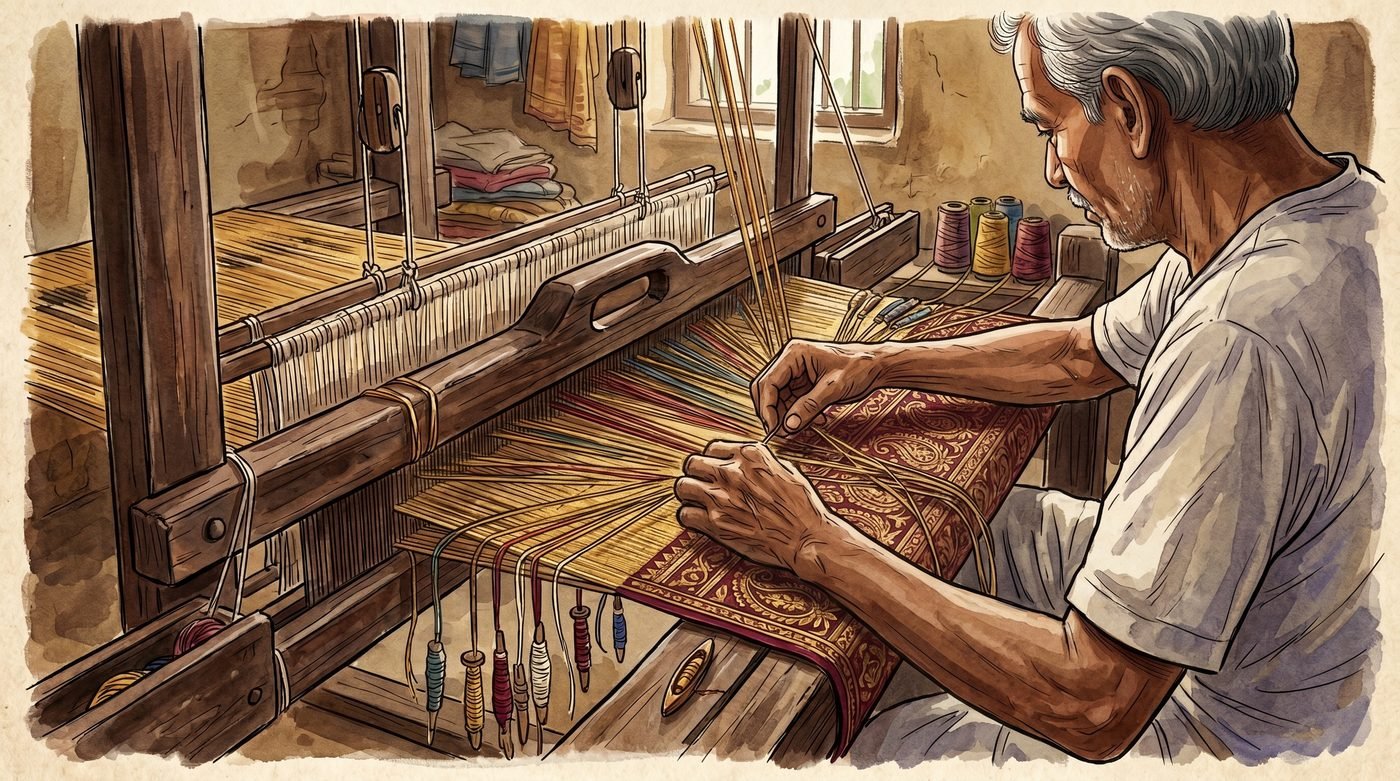
The body of a Bhagalpuri silk saree usually weaves at a steady pace. The borders and the pallu (the decorative end-piece that drapes over the shoulder) are an entirely different story. These often feature intricate motifs woven in contrasting yarn — paisleys, florals, geometric patterns, sometimes traditional Anga-region symbols.
For elaborate borders, weavers may use the extra-weft technique, where additional decorative threads are introduced beyond the basic weave. The pallu alone, on a high-end saree, can take 5 to 12 days. Some master weavers in Nathnagar specialise only in borders and pallus, working on multiple sarees handed to them by other weavers. This is why a finished saree often carries the work of five to eight different artisans, not just one.
Finishing — washing, calendering, and inspection
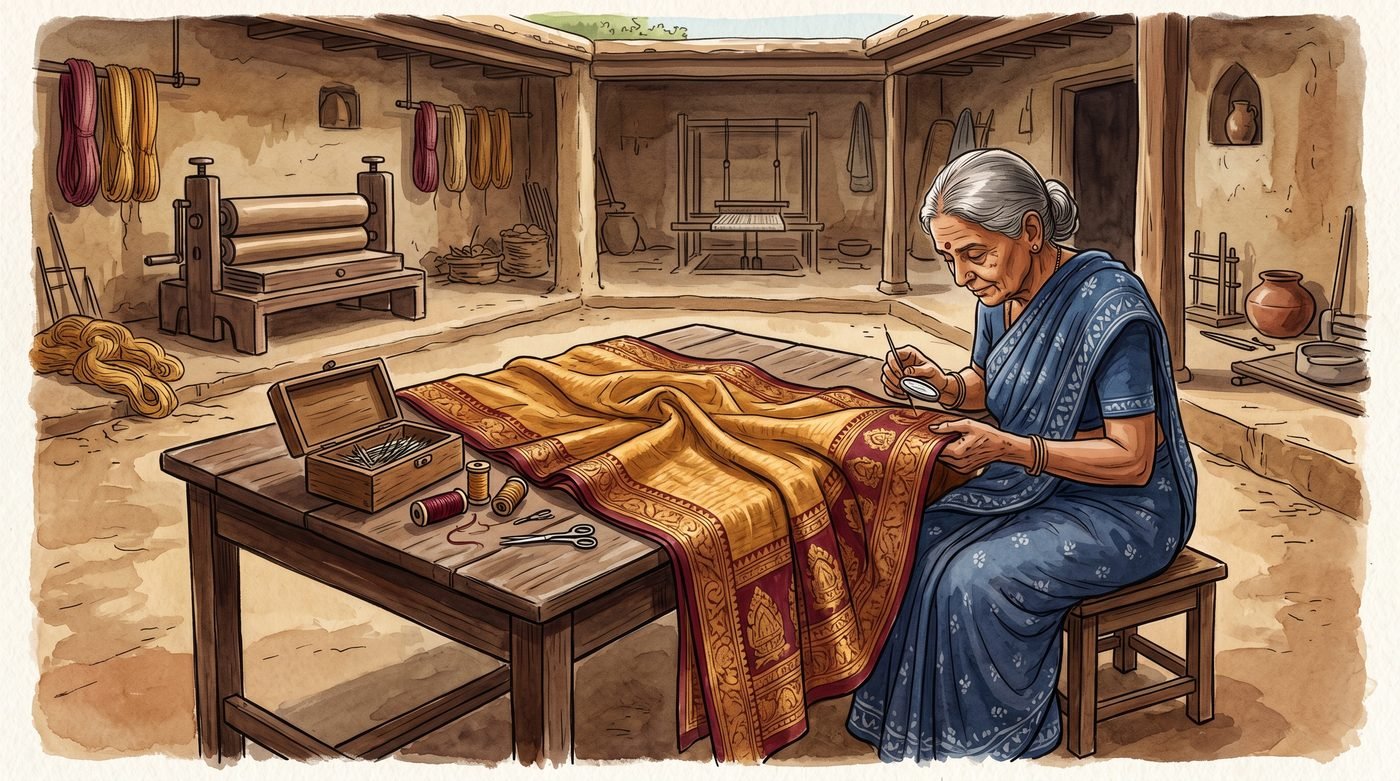
Once the weaving is complete, the saree is taken off the loom. Loose threads are clipped. The fabric is gently washed to remove any loom dust and starches used during weaving. It is then calendered — passed through smooth pressure rollers — which gives the saree its final lustrous finish without weakening the fibres.
The finished saree is then inspected by hand. Any small defects are repaired through delicate hand-mending. A single missed thread on the pallu, if not caught here, can make a saree unsellable in the export market.
GI tag and Silk Mark certification
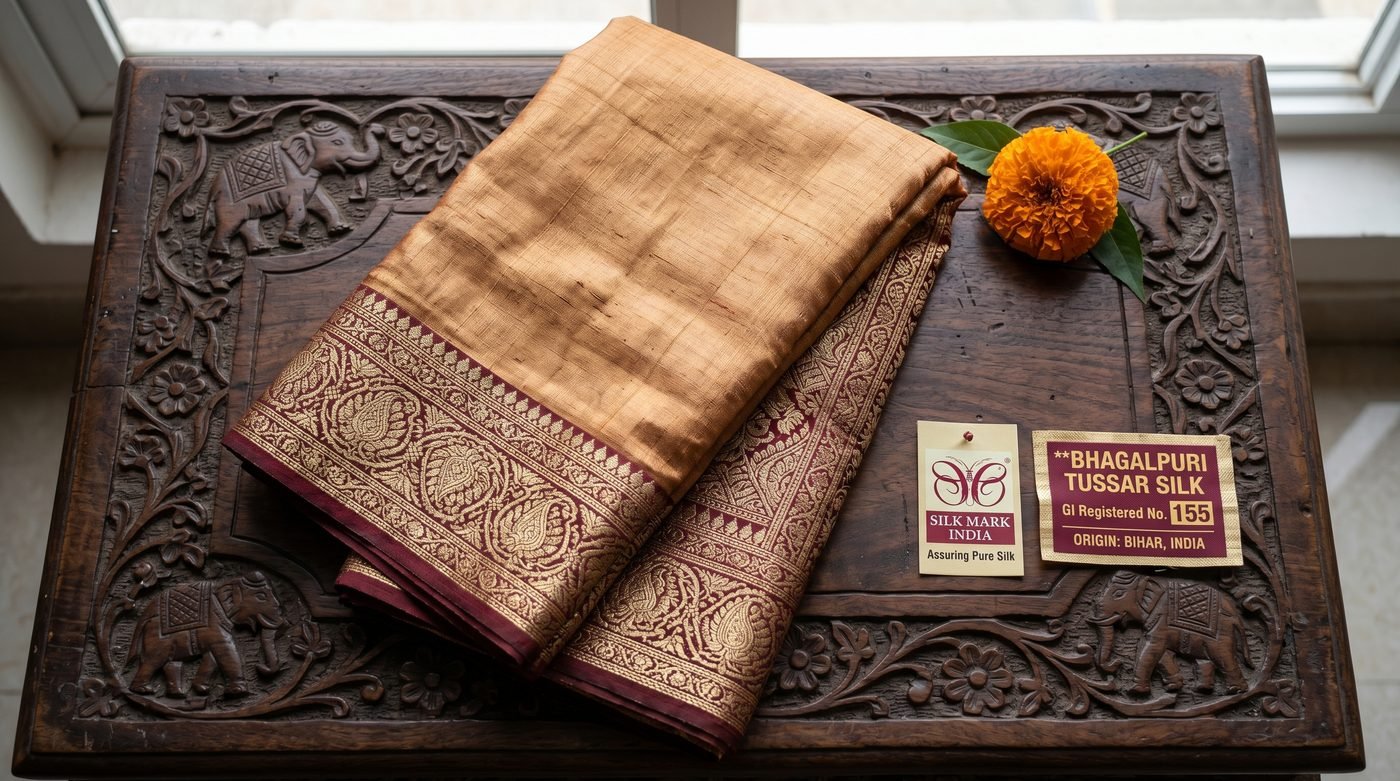
The final step is what distinguishes a genuine Bhagalpuri silk saree from imitations. Bhagalpuri silk holds an official Geographical Indication (GI) tag from the Government of India — registered under GI No. 155 — a legal certification that protects the name “Bhagalpuri silk” and guarantees the saree was made in the recognised Bhagalpur silk cluster using traditional methods.
Authentic sarees also carry the Silk Mark India label, issued by the Silk Mark Organisation of India under the Ministry of Textiles. This guarantees the cloth is genuinely silk (not silk-blend or polyester imitation). If you want the full picture of what the Bhagalpuri silk GI tag actually means and why it matters for buyers, that’s worth reading separately. For now, know this — if a saree is sold as “Bhagalpuri” but carries no GI tag and no Silk Mark, treat that as a red flag.
The math that should change how you buy
Let’s add up what one Bhagalpuri silk saree actually contains.
- Cocoon collection — half a day to a day of forest gathering
- Sorting, cooking, spinning — 5 to 7 days
- Twisting, degumming, dyeing, drying — 4 to 6 days
- Warping and loom setup — 2 to 3 days
- Weaving the body — 12 to 18 days
- Borders and pallu — 5 to 12 days for elaborate work
- Finishing, washing, mending, certification — 1 to 2 days
Total: somewhere between 30 and 45 working days, with five to eight different artisans contributing — a forest collector, a sorter, a cooker, a spinner, a dyer, a warper, a weaver, sometimes a separate border specialist. Each one paid for their work.
A genuine handwoven Bhagalpuri silk saree typically retails between ₹3,000 and ₹15,000, depending on yarn quality, dye type (natural versus chemical), and border complexity. Premium pieces with intricate hand-woven pallus and natural dyes can go up to ₹25,000 or more.
When you next see a “Bhagalpuri silk saree” online for ₹500 or ₹800, you now have the math to know exactly what is being sold. It is not Bhagalpuri silk. It is a power-loom imitation, often made of polyester or art silk, attempting to look like the real thing. There is nothing wrong with buying a polyester saree if that is what you want. There is something wrong with buying one while believing it is supporting a 1000-year-old craft.
What’s at stake — the quiet decline of a craft
The Bhagalpur handloom industry historically supported tens of thousands of weavers and workers. Estimates over the years have suggested around 30,000 weavers working on 25,000 handlooms, with the cluster’s annual turnover crossing ₹100 crore — much of it from exports.
Today, those numbers are shrinking. Power looms in other parts of India produce silk-look fabrics at a fraction of the cost. Younger generations in weaver families are leaving the loom for other work. Several traditional dyeing techniques are being lost as the older masters pass on without apprentices. The GI tag has helped — it gives weavers legal protection and a path to premium pricing — but enforcement is patchy and most consumers still don’t know to look for it.
Initiatives like the Berozgar Mahila Kalyan Sanstha (BMKS), founded with Dastkar’s support in 1993, have helped revive tussar weaving in the Godda district through training and design support. Several weaver cooperatives, NGOs, and private investors continue this work. But the long-term survival of authentic Bhagalpuri silk depends, ultimately, on buyers who know what they are buying.
How to recognise an authentic Bhagalpuri silk saree
If you are buying online or from a shop you don’t know well, here are five practical checks. None of them require expert training.
- Look for the GI tag (No. 155). A genuine Bhagalpuri silk saree should carry an official GI tag certifying it was produced in the recognised Bhagalpur silk cluster. No GI tag, no certainty.
- Look for the Silk Mark India label. This is a small round hologram-style label issued by the Silk Mark Organisation of India. It guarantees the cloth contains a verified percentage of pure silk.
- The burn test (if you have a few spare threads). Take a few threads from an inconspicuous corner of the saree (the pallu’s far end, for example) and burn them. Pure silk burns slowly, smells like burning hair, and leaves a brittle black ash that crumbles easily. Polyester smells like burning plastic, melts into a hard bead, and shrinks away from the flame. This test is irreversible — only do it on a saree you have already purchased and want to verify.
- Look for slubs and gentle irregularities. Real Bhagalpuri tussar silk has visible slubs — tiny thickened spots in the yarn — and small variations in the weave. These are not defects. They are evidence of hand-spinning. Power-loom imitations have completely uniform thread thickness and a slight artificial sheen.
- Check the weight and drape. Real tussar silk is medium to heavy in weight — heavier than mulberry silk of the same weave. It drapes with a slight stiffness initially, then softens with each wear. Light, slippery, overly shiny “Bhagalpuri silk” is almost always polyester or art silk.
One more practical tip: if you are buying online, look for sellers who can name the weaver cluster, who show pictures of the actual weaving process, and who can provide the GI tag and Silk Mark certificates on request. A genuine seller will always be happy to. An imitation seller will deflect.
If you want to feel the real difference yourself, the simplest way is to handle a verified piece — even a small stole or dupatta in pure Bhagalpuri tussar will teach you what real silk feels like in a way no article ever can. Authentic GI-tagged Bhagalpuri tussar silk sarees are available from a handful of verified sellers online — verify the certifications before you buy.
Closing — a saree is not just cloth
What you have read above happens, right now, in homes and small workshops across Nathnagar, Champanagar, the Godda district, and a few surrounding silk villages. People are spinning. Yarn is being dyed in earthen vats. Pit looms are creaking in the early morning. None of this is a museum exhibit. It is a living industry — quieter than it once was, and threatened, but very much alive.
When you buy a real Bhagalpuri silk saree, you are paying for thirty to forty-five days of skilled human work, the survival of a craft that has been continuous since the time of the Anga kingdom, and a small but real share of the income going back into the hands that wove it. None of that is captured in the photos on a product page. But every thread of it is in the cloth.
For our Hindi-speaking readers, we have a complete Bhagalpur silk city vibhrast guide in Hindi — covering the same heritage from a slightly different angle. And for the deeper civilizational story of how Bhagalpur became India’s Silk City over a thousand years, our complete story of Bhagalpur, India’s Silk City is worth a read.
⚡ ABOUT ANGIKASILK
We document Bhagalpur’s silk heritage from inside the city itself — not from a marketing desk in Mumbai or Delhi. Every story we publish is rooted in this land, these looms, and these weavers.
If this guide helped you understand what you’re really buying, share it with one person who buys silk.
From Nathnagar with respect — for the weavers who keep the looms running.