No Bias
Fact-Checked
April 2026
Most online comparisons of Bhagalpuri and Banarasi silk get it wrong. They frame it as a competition. They add bias. They pick a winner.
The truth is more interesting: Bhagalpuri and Banarasi silk are not the same type of silk at all. They come from different silkworms, different states, different cultural traditions, different weaving techniques, and are made for different purposes.
Comparing them is less like comparing two competing products and more like comparing a handwoven cotton from Kutch with a heavy Kanjeevaram — the question is not which is better, but which is right for what you need. This guide gives you only verified, original data — no opinions dressed up as facts.
Bhagalpuri silk is wild tussar silk from Bihar — earthy, lightweight, affordable, made by Antheraea silkworms that feed on forest leaves. Banarasi silk is cultivated mulberry silk from Varanasi — smooth, heavy, opulent, made by Bombyx mori silkworms raised on mulberry leaves. Neither is superior. They serve different wearers, different occasions, and different aesthetics.
- Origin — where each silk comes from
- The silkworm — the root difference between both silks
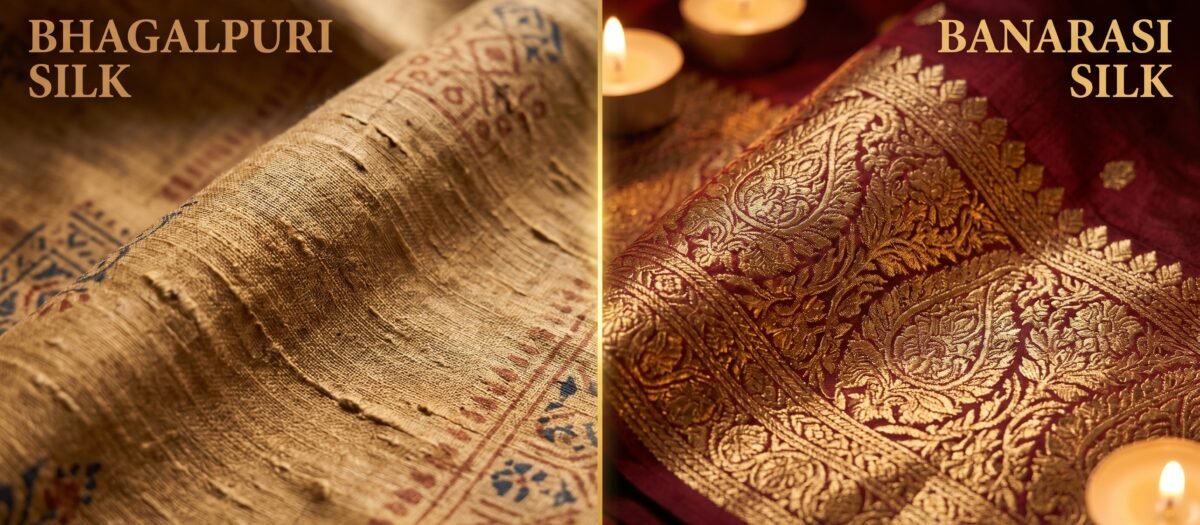
- Texture, weight and natural colour
- Weaving technique
- Design vocabulary and motifs
- GI Tag status
- Price range (real market data)
- Best occasions for each
- Care and maintenance
- Side-by-side master comparison table
- Which should you buy?
1. Origin — Where Each Silk Comes From
Bhagalpuri Silk — Bhagalpur, Bihar
Bhagalpuri silk originates from Bhagalpur, a city on the banks of the River Ganga in Bihar, eastern India. The city is officially known as the “Silk City of India” — a title earned over more than 200 years of continuous silk weaving tradition.
- Over 30,000 weavers work in Bhagalpur
- More than 25,000 handlooms operate in the city
- Annual industry turnover: approximately ₹100 crore
- 80% of production is exported — to Europe, Australia, North America
- The weaving tradition here is over 200 years old
Banarasi Silk — Varanasi, Uttar Pradesh
Banarasi silk originates from Varanasi (also called Banaras or Benares) in Uttar Pradesh, one of the world’s oldest continuously inhabited cities. The tradition of silk brocade weaving here dates to the Mughal era, when Persian weaving techniques were introduced by Mughal emperors and blended with existing Indian design vocabularies.
- Approximately 1.2 million people are directly or indirectly employed in the Banarasi silk industry
- GI protection covers 6 districts: Varanasi, Mirzapur, Chandauli, Bhadohi, Jaunpur, Azamgarh
- Silk threads for Banarasi weaving are sourced from Karnataka, West Bengal, and Tamil Nadu
- The design tradition blends Persian art, Mughal architecture, and Indian motifs

2. The Silkworm — The Root of Every Difference
Every difference between Bhagalpuri and Banarasi silk — the texture, the colour, the weight, the drape, the price — traces back to a single fact: they are made by different species of silkworms eating different food.
Bhagalpuri Silk
Silkworm species: Antheraea mylitta (Indian tussar) and related Antheraea species
Type: Wild silkworm — lives in open forests, not domesticated
Food: Oak leaves, Arjun leaves, Sal leaves — forest vegetation
Silk thread: Produced in batches — threads cut at irregular intervals. Naturally shorter than mulberry threads.
Natural colour: Golden-brown / copper — from the forest leaves the silkworm consumes
Process: Ahimsa (non-violent) — many producers allow the moth to emerge before harvesting the cocoon. The silkworm is not killed.
Banarasi Silk
Silkworm species: Bombyx mori — the cultivated mulberry silkworm
Type: Domesticated — raised in controlled sericulture farms
Food: Mulberry leaves only — cultivated on mulberry farms in Karnataka, West Bengal, Tamil Nadu
Silk thread: One single continuous thread per cocoon — extremely fine, uniform, and long. Requires 2,500–3,000 cocoons per saree.
Natural colour: Pure white/cream — dyed in desired colours before weaving
Process: Conventional sericulture — cocoons are boiled to kill the pupa and obtain the full continuous thread length
Key fact: Mulberry silk (Bombyx mori) accounts for over 90% of global silk production. Tussar silk (Antheraea) is a minority product — coarser, rarer, and distinctly different in character. India produces approximately 130 tonnes of tussar silk annually versus thousands of tonnes of mulberry silk.
3. Texture, Weight and Natural Colour
| Property | Bhagalpuri (Tussar) Silk | Banarasi (Mulberry) Silk |
|---|---|---|
| Texture | Slightly rough, irregular, textured. Visible weave irregularities — a natural characteristic, not a defect. | Smooth, fine, uniform. The tightly twisted mulberry threads produce a consistently smooth surface with deep lustre. |
| Weight | Lightweight to medium. Comfortable for long hours. Suitable for warm weather. | Medium to heavy (Katan variety is heaviest). The zari work adds significant weight. Structured and stiff in drape. |
| Natural colour | Golden-brown / copper — a warm, earthy natural hue that comes directly from the forest leaves the silkworm eats. This colour cannot be replicated synthetically. | Pure white / cream. The thread is naturally colourless and takes on any dye colour with vivid intensity — explaining why Banarasi sarees appear so saturated and rich. |
| Sheen | Subtle, warm, matte-to-low-sheen. Does not reflect light aggressively. Has a natural, organic glow. | High lustre, mirror-bright where zari is present. The smooth mulberry base maximises the reflective quality of the zari threads. |
| Drape | Fluid, soft, falls naturally. Forms pleats easily. Easier to wear for long durations. | Structured and formal in Katan variety. Softer in Georgette. The weight holds the saree in a rigid, sculptural shape. |
| Breathability | High. Tussar silk is naturally more breathable than mulberry silk — suitable for outdoor, summer, and daytime events. | Lower in heavy Katan variety. The density of the weave and the zari work makes it less suitable for hot outdoor wear. |

4. Weaving Technique
Bhagalpuri Silk — Print-Friendly Weave
The weave of Bhagalpuri tussar silk is relatively open and receptive to dyes and surface treatments. This is why Bhagalpuri sarees are famous for block printing, natural dyeing, Madhubani painting, and Kantha embroidery — techniques applied to the surface of the fabric after weaving.
- The irregular thread length of tussar (because it is not one continuous thread) creates a naturally textured, varied surface
- The fabric is harder to bleach and dye uniformly than mulberry silk — requiring specific dyeing processes
- Modern demineralization techniques have improved dye absorption significantly
- The open weave makes it more breathable than tightly woven mulberry silk
- Major designers like Sabyasachi and Manish Malhotra have used Bhagalpuri tussar for surface embellishment work
Banarasi Silk — Brocade Weaving
Banarasi weaving is primarily brocade work — the design is created during the weaving process itself, not added afterward. This is the defining distinction. The zari (gold or silver metallic thread) is woven directly into the fabric as the saree is made, creating motifs that are structurally part of the textile.
- Kadhwa weave: Each motif woven separately. Two weavers work simultaneously — one weaves the body, one creates each motif with a wooden spool (tilli). Minimum 12–14 days per saree. Up to 8–9 months for complex pieces.
- Phekwa weave: Weft yarn interlaced from end to end. Leaves threads at the back that are cut after completion. Faster than Kadhwa.
- Tanchoi weave: Extra weft technique with multiple coloured threads. Extremely intricate, produces velvety surface. No cut threads at back.
- Jacquard loom: Design transferred to punch cards — one pattern requires hundreds of cards. The loom reads these cards to weave motifs automatically but still requires master weavers to operate.
- A single traditional Banarasi saree requires 2,500–3,000 cocoons worth of silk thread.
A complex Banarasi Kadhwa saree can take up to 6 months to complete. A standard handloom Banarasi takes a minimum of 15 days. In contrast, a Bhagalpuri tussar saree woven on handloom takes 3–7 days for the base weave — with additional time for surface work like block printing or embroidery.
5. Design Vocabulary and Motifs
Bhagalpuri Silk — Design Sources
- Block prints — traditional hand-carved wooden blocks
- Natural dyes — turmeric, indigo, pomegranate
- Madhubani painting — hand-painted directly on fabric
- Kantha embroidery — running stitch patterns
- Shibori tie-dye — Japanese-influenced resist dyeing
- Zari borders — added as a border element, not woven throughout
- Motifs: nature-inspired — trees, animals, folk patterns, geometric
Banarasi Silk — Design Sources
- Kalga — mango/paisley motif (Mughal origin)
- Jhallar — lattice border with upright leaves
- Butidar — all-over floral sprigs across the body
- Shikargah — hunting scenes from Mughal court art
- Meenakari — coloured silk threads create jewel-like colour fills
- Jal — net-like all-over pattern across the body
- All designs are woven into the fabric — not printed, painted or embroidered
6. GI Tag Status
Bhagalpuri Silk — GI Tag
Bhagalpuri silk holds a Geographical Indication (GI) registration. This means only silk produced in the designated Bhagalpur region qualifies as authentic Bhagalpuri silk.
When buying, look for the Silk Mark certification from the Silk Mark Organisation of India — this guarantees the percentage of natural silk content in the fabric.
Banarasi Silk — GI Tag
Banarasi silk received its GI tag in 2009. The tag covers six districts: Varanasi, Mirzapur, Chandauli, Bhadohi, Jaunpur, and Azamgarh. Only sarees made in these districts can legally be called Banarasi.
Authentic Banarasi sarees also carry the Silk Mark and the GI tag includes a unique serial number and hologram for verification. Power-loom imitations are widespread in the market — the GI tag is the primary protection against fakes.
7. Price Range — Real Market Data (2026)
These price ranges are sourced from verified online marketplaces and specialist retailers as of April 2026. Prices vary based on weave complexity, zari content, and seller authenticity.
| Category | Bhagalpuri Silk | Banarasi Silk |
|---|---|---|
| Entry level | ₹2,000–₹5,000 | ₹20,000–₹30,000 (handloom) | ₹2,000–₹8,000 (power loom — not authentic) |
| Mid range | ₹5,000–₹12,000 | ₹30,000–₹80,000 |
| Premium | ₹12,000–₹25,000 (with Madhubani painting or heavy embroidery) | ₹80,000–₹2,00,000+ |
| Collector / Heirloom | ₹20,000–₹50,000+ (pure handloom, hand-painted) | ₹2,00,000+ (complex Kadhwa, pure Katan, antique zari) |
Important note on Banarasi pricing: A genuine handloom Banarasi saree below ₹15,000–₹20,000 is extremely unlikely. If you find one being sold as “authentic Banarasi” at ₹3,000–₹5,000, it is almost certainly a power-loom imitation — not a handloom saree from Varanasi. Always verify the GI tag and Silk Mark certification before purchase.
8. Which Silk for Which Occasion?

| Occasion | Bhagalpuri Silk | Banarasi Silk |
|---|---|---|
| Everyday / Office | ✅ Excellent — lightweight, breathable, comfortable for full working day | ✗ Too heavy, too formal, too expensive for daily wear |
| Casual functions / Puja | ✅ Excellent — earthy tone and natural quality appropriate for religious occasions | ✅ Suitable — though considered over-dressed for casual functions |
| Festivals | ✅ Very good — block print and Kantha varieties particularly festive | ✅ Excellent — the Georgette and Organza varieties work well for daytime festivals |
| Wedding Guest | ✅ Good choice — appropriate, elegant, won’t outshine the bride | ✅ Excellent — heavy Banarasi as a wedding guest signals serious dressing |
| Bride / Bridal | ⚡ Occasionally chosen — more common in progressive brides who prefer understated elegance over heavy silk | ✅ The traditional bridal first choice — the Katan Banarasi in red is the most iconic bridal saree in North India |
| Summer / Outdoor | ✅ Excellent — breathable and light. The right choice for outdoor summer weddings and daytime functions. | ✗ Heavy Katan not ideal outdoors. Organza or Georgette Banarasi is a better option if choosing Banarasi for warm weather. |
9. Care and Maintenance
Bhagalpuri Silk Care
- First wash: Dry clean. Sets dye and prevents colour bleed.
- Home wash: Cold water, mild detergent, no wringing. Do not machine wash.
- Drying: Flat dry in shade. Never direct sunlight — bleaches the natural golden tone.
- Ironing: Low heat with cotton cloth between iron and fabric.
- Storage: Muslin cloth wrapping. Neem leaves to prevent insects.
- Durability: Tussar silk is naturally more durable than mulberry silk due to the wild silkworm’s stronger thread.
Banarasi Silk Care
- Always dry clean — especially for zari-heavy varieties. Home washing risks zari tarnishing.
- Never hand wash a Katan Banarasi — the weight and structure can be permanently distorted.
- Ironing: Low heat only. Never iron directly on zari — it permanently damages the metallic threads.
- Storage: Muslin cloth. Silica gel packets to prevent humidity. Re-fold along different lines every 6 months to prevent permanent crease marks.
- Zari care: Store near camphor or neem (not touching) to prevent tarnish. Avoid plastic wrapping.
- Durability: A well-cared-for Banarasi saree is an heirloom — it can last 50–100 years.
10. Master Comparison Table
| Factor | Bhagalpuri (Tussar) Silk | Banarasi (Mulberry) Silk |
|---|---|---|
| Origin | Bhagalpur, Bihar | Varanasi (+ 5 districts), Uttar Pradesh |
| Silk type | Tussar (wild silk) | Mulberry (cultivated silk) |
| Silkworm | Antheraea (wild) | Bombyx mori (cultivated) |
| Silkworm food | Oak, Arjun, forest leaves | Mulberry leaves |
| Natural colour | Golden-brown / copper | Pure white / cream |
| Texture | Slightly rough, irregular, earthy | Smooth, uniform, lustrous |
| Weight | Light to medium | Medium to heavy |
| Sheen | Subtle, warm, low-sheen | High lustre, mirror-bright at zari |
| Design method | Surface treatment — block print, Madhubani, Kantha, Shibori | Brocade — zari woven into fabric during weaving |
| Weaving time | 3–7 days (base weave) | 15 days to 6 months |
| GI Tag | Registered GI | GI Tag since 2009 |
| Price range | ₹2,000–₹25,000 | ₹20,000–₹2,00,000+ (handloom) |
| Breathability | High — suitable for warm weather | Lower in heavy Katan — better in Georgette/Organza |
| Best for | Everyday, office, festivals, casual functions, summer weddings | Grand weddings, bridal trousseau, formal occasions, heirloom investment |
| Ahimsa (non-violent) | Yes — many producers allow moth to emerge before harvesting | No — conventional sericulture boils cocoons to obtain thread |
11. Which Should You Buy?
There is no correct answer in the abstract. The right silk is the one that fits your actual need. Use this decision framework:
Choose Bhagalpuri Silk if:
- You want silk for regular use — office, functions, festivals
- You prefer earthy, natural, organic aesthetics
- You want a breathable saree for warm weather or outdoor events
- Your budget is ₹2,000–₹15,000
- You appreciate hand-printed or painted textiles
- You want to support Bihar’s weaving tradition directly
- You prefer Ahimsa (non-violent) silk production
- You want something distinctive that won’t be seen at every wedding
Choose Banarasi Silk if:
- You are a bride or part of the core bridal family
- You want maximum visual impact at a grand event
- You prefer smooth, lustrous, opulent fabric
- You want a long-term heirloom investment (50–100 year lifespan)
- Your budget is ₹20,000 and above for authentic handloom
- You prefer woven-in brocade patterns over surface printing
- You want North India’s most recognised bridal silk tradition
The Honest Summary
Bhagalpuri silk and Banarasi silk are both extraordinary — but in completely different ways. Bhagalpuri silk gives you nature, breathability, earthy authenticity, and accessibility. Banarasi silk gives you history, opulence, brocade artistry, and permanence.
India is fortunate to have both. The right question is never “which is better?” — it is “which do I need right now, and for what?”
Bhagalpuri silk vs Banarasi silk, tussar silk vs banarasi silk, bhagalpuri vs banarasi comparison, which silk is better India, silk saree comparison India, bhagalpuri silk facts, banarasi silk facts, tussar silk facts, antheraea silkworm, bombyx mori silkworm, wild silk vs mulberry silk, bhagalpuri silk origin, banarasi silk origin, varanasi silk, bhagalpur silk city, silk city India, GI tag silk saree, banarasi GI tag 2009, bhagalpuri GI tag, tussar silk GI, silk mark India, banarasi silk price 2026, bhagalpuri silk price 2026, katan banarasi saree, banarasi organza saree, banarasi georgette saree, tanchoi banarasi, kadhwa banarasi, banarasi weaving technique, bhagalpuri block print, madhubani silk saree, kantha embroidery tussar, shibori bhagalpuri, banarasi motifs, kalga motif, jhallar banarasi, butidar saree, shikargah banarasi, meenakari banarasi, bhagalpuri silk texture, banarasi silk texture, tussar silk colour, banarasi silk colour, silk saree weight comparison, breathable silk saree, ahimsa silk India, peace silk India, silk saree for office, silk saree for wedding, silk saree for everyday, bridal banarasi saree, bhagalpuri saree wedding guest, silk saree care India, how to store silk saree, dry clean banarasi, banarasi heirloom saree, silk saree buying guide India, how to identify pure silk, burn test silk, silk mark certification, original banarasi saree buy, original bhagalpuri saree buy, banarasi saree authentic, tussar silk authentic, saree comparison guide India, angika silk comparison, bhagalpur saree, varanasi saree, north India saree, east India saree, silk saree Bihar, silk saree UP